Showing posts with label fate. Show all posts

Wednesday, May 6, 2020

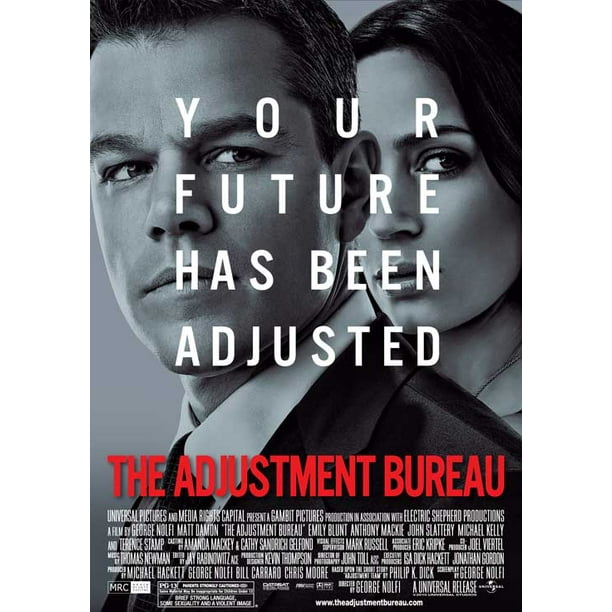
Blog #91 - Thoughts about The Adjustment Bureau

Image result for adjustment bureau philosophy

While we watched the Adjustment Bureau, I had several questions as I'm sure many of you did too. Here were several of them:

1. Who was the Chairman in the film (I know that somebody found info that the director said that the Chairman was a female character in the film)? Did Norris and / or Elise see the Chairman during the film or was it earlier in their lifetimes before the film ever began? (Do you buy my idea that it was the guy that said hi to Norris on the street after the second time Norris and Elise meet?)

2. When Harry said to Elise and Norris that the Chairman rewrote the plan, the book showed a blank space ahead for the two of them.  What do you think that meant?  Does the blank space mean that David and Elise get to forge their own destiny?  Or does it mean something else?  Explain.  And what does this say about the mind of the Chairman, that two humans can change the

3. Kids in past classes have asked why there weren't any female adjusters.  I didn't have an answer for them as to that question.  I have also criticized the film's Western / Euro - centered bias when it talked about giving mankind free will during the Roman times and the Cuban Missile Crisis.  Assess the film in light of these flaws.

Review: The Adjustment Bureau - Slant Magazine

4. Why do you think the filmmaker decided never to show the Chairman in his/her/its true form?  By leaving this question unanswered, what was the filmmaker's intent? 

5. Think about Harry's crisis of conscience when Elise and David broke up for the 3rd time (when he left her at the hospital), and he asked Richardson about the rightness of the plan.  Put yourself in one of the adjusters' shoes and try to make sense of it all when you're only given part of the picture. Does this limited view of the big picture reflect our own view on life in general?  Why or why not?

6. Do you agree with Thompson when he says that "free will is an illusion"?  Why or why not? 

7. What is the filmmaker saying about order and chaos when Thompson tells us about the times when humans had free will and made a complete mess of the world? 

8. Looking at Harry's statement at the end (see below), what do you think is the filmmaker's message? Why?


“Most people live life on the path that we set for them to afraid to explore any other [path]/ Sometimes, someone like you comes along and knocks down the obstacles that we put in your way. People should realize that free will is a gift that you’ll never know how to use until you fight for it. I think that’s the Chairman’s real point. And maybe one day, we won’t write the plan, you will.”

Pick four of these questions and answer them for Friday May 8 by 11:59 pm.  400 words minimum for your total answer.  Thanks. 
The Adjustment Bureau (2011) 27x40 Movie Poster

Thursday, April 18, 2019

Blog #83 - Adjustment Bureau and Fate vs. Free Will

While we watched the Adjustment Bureau, I had several questions as did many of you. Here were several of them:

1. Who was the Chairman in the film (I know that somebody found info that the director said that the Chairman was a female character in the film)? Did Norris and / or Elise see the Chairman during the film or was it earlier in their lifetimes before the film ever began? (Do you buy my idea that it was the guy that said hi to Norris on the street after the second time Norris and Elise meet?)

2. When Harry said to Elise and Norris that the Chairman rewrote the plan, the book showed a blank space ahead for the two of them.  What do you think that meant?  Does the blank space mean that David and Elise get to forge their own destiny?  Or does it mean something else?  Explain.  And what does this say about the mind of the Chairman, that two humans can change the

3. Kids in past classes have asked why there weren't any female adjusters.  I didn't have an answer for them as to that question.  I have also criticized the film's Western / Euro - centered bias when it talked about giving mankind free will during the Roman times and the Cuban Missile Crisis.  Assess the film in light of these flaws.

Image result for adjustment bureau philosophy

4. Why do you think the filmmaker decided never to show the Chairman in his/her/its true form?  By leaving this question unanswered, what was the filmmaker's intent? 

5. Think about Harry's crisis of conscience when Elise and David broke up for the 3rd time (when he left her at the hospital), and he asked Richardson about the rightness of the plan.  Put yourself in one of the adjusters' shoes and try to make sense of it all when you're only given part of the picture. Does this limited view of the big picture reflect our own view on life in general?  Why or why not?

6. Do you agree with Thompson when he says that "free will is an illusion"?  Why or why not? 

7. What is the filmmaker saying about order and chaos when Thompson tells us about the times when humans had free will and made a complete mess of the world? 

8. Looking at Harry's statement at the end (see below), what do you think is the filmmaker's message? Why?

“Most people live life on the path that we set for them to afraid to explore any other [path]/ Sometimes, someone like you comes along and knocks down the obstacles that we put in your way. People should realize that free will is a gift that you’ll never know how to use until you fight for it. I think that’s the Chairman’s real point. And maybe one day, we won’t write the plan, you will.”

Tuesday, March 26, 2019

Blog #82 - Questions concerning The Source Code

We talked a bit about the film, Source Code, and how it relates to Plato's Allegory of the Cave.  I don't know if it's a perfect fit, but what is?  I think further research is needed for this topic and if you guys can find it pertaining to the film and Plato, that would be great (don't forget to read the illustrated handout on Plato, the cave, what it means, and his ideal society for more details).

The film opens up some questions about fate that I don't think it really answered or that we really touched upon too much.  When Capt. Stevens kept being pulled out of the Source Code (SC) and back into his "capsule," he saw these glimpses - call them deja vu, precognition, whatever - of himself and Christina at Chicago's Millenium Park and the big chrome bean.  These scenes occurred even before he felt like saving anybody on the train or understood his situation - as if he was headed towards that future "alternate universe" no matter happened.  Could it be that every obstacle that Stevens ran into (or literally ran into him - see below!) kept him moving towards that unavoidable future?


Image result for source code movie

What about the morality of using Capt. Stevens as a lab rat for the Source Code?  It's obvious by the end of the movie that he's in a terrible state of physical trauma, and that only his mind is the most complete and functioning part of him.  At points in the film, it appeared that Dr. Rutledge was "torturing" Stevens by sending him back into the memories of Sean Fentress only to be blown up again and again.  We did mention that Capt. Stevens, as a member of the U.S. military, most likely, had signed away his rights to do with his remains as his parents wished.  However, it is hard to imagine a father wishing this for his son.  And by the end of the film, if it has reset and everything starts anew, Capt. Stevens will continue to be used further in the GWOT (global war on terror).

One question I kept having while first watching the movie (and occasionally in rewatching it with previous philosophy classes), is what happened to Sean Fentress's essence or soul or being?  Captain Stevens takes over Sean's body, his likeness doesn't change, but his demeanor and actions do, as evidenced by Christina noticing how different he is acting on subsequent trips into the Source Code.  Dr. Rutledge says that Sean Fentress exists in the Source Code as an electromagnetic field.  But where did his essence go?  Does Sean's essence / soul / being cease to exist as soon as Capt. Stevens enters Sean's body?  Or did it cease to exist as soon as he died and this "Sean" is just a shadow of his former self?   Does Sean's essence go somewhere else (maybe heading to heaven or hell or limbo, depending upon what you or even Sean believed)?  Is his essence maybe going some place permenantly because he doesn't come back to his body after the end of eight minutes - the bomb goes off and Sean and Christina and dozens other people die?  Or since we're watching a memory replay over and over again, is the whole point of where Sean is a moot point because at that point, Sean and many others are already dead and just live on in the memory?  Plus at the end of the movie, we see Sean and Christina walking by Millenium Park enjoying a beautiful spring day playing hooky in some kind of memory(?) that couldn't have happened because the bomb didn't go off.  Has the real Sean returned?  Or is that still Capt. Stevens in his body?

One more question that I thought of while watching the movie again was this: are all of these trips into the Source Code with all of their different outcomes just part of a multiverse?  Essentially, all of these trips have the same setting, the same laws of physics still apply, the same people in them, and essentially the same outcome (except for the last one) but the one wild card that changes every time is what Captain Stevens does within the eight minutes.  Do all of these of these trips comprise different versions of a multiverse?  And since the theory behind a multiverse states that almost all outcomes of an event are possible, that could leave room for one "reality" in which the bomb didn't go off.

Lastly, how do you explain the ending?  Goodwin and Rutledge have no knowledge of the previous day's events (if those events even occurred - but they had to have existed somewhere, b/c Stevens sent her the email - it came from somewhere, sometime, right?).  And at the end of the movie, it looked as if the whole day had been reset, Capt. Stevens was alive and in his previous "state of being," in addition to the bomber being caught and the initial train bombing never having occurred.

Questions to choose from:
1. How could the filmmakers have changed the film to make it more like Plato's cave?  Explain your reasoning.
2.  What role did fate play in this movie?  Why?  Or, did fate play no role at all and why not?
3.  Did the military cross the line with the use of Capt. Stevens' body and mind for the Source Code?  Why or why not?
4. Where did Sean Fentress's essence / soul / being go while Captain Stevens took over his body in the Source Code?  Why?
5. Is the ending a new "movie reality" (for lack of a better term)?  Why or why not?  Is it possible that Stevens' determination somehow merged the alternate universe with the movie's original reality?


Pick three of the following questions and answer it as fully as you can.  Stay in the nuances of the question as long as you can.  Your response should be a minimum of 400 words and is due Friday, March 29 before class begins. 

Here are a few interesting articles that explore some other issues brought up in the film: 
"Who is Sean Fentress? A Completely Serious Exploration of What Happened After the Ending of Source Code" - https://filmschoolrejects.com/who-is-sean-fentress-e3ddff9993a/ 
"Here I Am: The Identity Philosophy behind Source Code" - https://filmschoolrejects.com/here-i-am-the-identity-philosophy-of-source-code-78cbe40abd2f/ 
"The Philosophy Behind The Source Code" - https://maxandrews.wordpress.com/2011/06/15/the-philosophy-behind-source-code/ 

Thursday, April 13, 2017

Review for Hellenism, Christianity, Renaissance, and Baroque Test

Review for the Hellenism, Christianity, Renaissance, and Baroque Test - Wednesday, April 19 - https://docs.google.com/document/d/1allQR65am8hNnzFvCZiehgk3qfLaSx5bKsmMobP9LmY/edit?usp=sharing

Crash Course - Anselm and Ontological Argument for God.


Crash Course - Aquinas and the Cosmological Arguments for God


Crash Course - Intelligent Design / Teleological Argument for God


Wednesday, April 24, 2013

Blog #62 - Reactions to Henry Poole is Here

Pick one of the following topics and write about it based on your own personal experience 

1. You can’t go to the past to fix the present.” - Esperanza said when Henry visited his parents' house. Agree or disagree? Why?


2. Noam Chomsky said: "As soon as questions of will or decision or reason or choice of action arise, human science is at a loss" 1.


Patience quotes him in the movie, and then follows it up with these lines: "It means that not everything needs an explanation. Sometimes, things happen b/c we choose for them to happen. I chose to believe."


Is she saying that because she believed the miracle on Henry's wall to be true, then that made it true? Or is she saying something else? If you could choose for one thing to come true / exist, what would that be and why?
 
3. During the dinner date, Dawn said to Henry as he tried backing away from getting closer to her was: "I know you're gonna die. But all that either of us have is right now, and we should pay attention to that." We talked today about how Henry might be feeling selfish and keeping people out w/ the way he's acting. But when he said, "I am paying attention." And that's why he can't do this (meaning fall for Dawn, go where the date will eventually lead ). Did Henry stop being selfish there for a moment? Or did he revert back to himself again? Why?


4. I get the feeling that Henry senses that there are greater forces at work, somehow helping him, coming to heal him, yet he feels unworthy of this sense of grace. Why he feels unworthy, I don't know. Maybe it's not unworthy, maybe it's pride or stubbornness in his own beliefs that life has just dealt him an awful hand. Maybe he has accepted this fate, for lack of a better word, and decided to deal with it in his own way despite a higher power demanding an audience. What do you think of this idea?

5. There's got to be a reason why Patience is named Patience. What about the name Esperanza? It's Spanish for Hope. what made me think about Hope (besides the Obama-themed poster of Henry) was when he was about to destroy the wall and he yelled, "Hope can't save you!" And the last of the virtues would be Love symbolized by Dawn and Faith by Millie (who was the first one to test the validity of the wall).

Henry, on the other hand, would symbolize the seven deadly sins - sloth, gluttony, lust, greed, anger, envy and pride. A stretch? Maybe. How would he symbolize the seven?


6. Do you think Henry symbolizes Descartes' skepticism of one's senses?  Or does Henry go beyond that to a total skepticism of everything: religion, senses, peoples' good intentions, etc. until he finally discovers that he's not going to die?  Why?


7. "Everything happens for a reason."  When Esperanza talks to Henry about her old boyfriend, Leo, and how that she prayed to God to give her a sign that Leo was o.k., how does the sign on Henry's wall signify an answer to her prayers?  

Due Thursday, April 25 by class.  (200 words minimum).

Saturday, April 13, 2013

Blog #61 - Fate and Free Will in the Matrix

After watching The Matrix this semester for what seems the umpteenth time, I was searching for something new to talk about.  This time, as with all good art, we can gather something new from it upon repeat viewings.

My question is: where do you see fate and / or free will in the movie?

Neo seems to disagree with the concept of fate (or the more technical term, determinism) "I don't like to think that I'm not in control of my life."  In fact, he seems to use free will by choosing the blue pill over the red pill when Morpheus gives him the options.

There are other scenes where Morpheus seems to give Neo choices - "I'm just trying to show you the door.  You're the one who has to walk through it" -  right before they go to visit the Oracle.  Morpheus also seems to make the choice to sacrifice himself when the agents attack the group in order to capture Neo.  Also, Neo appears to make the choice to go back into the Matrix to save Morpheus.  Even the Oracle tells Neo, "you don't believe in all that fate crap.  You're in control of your own life."


But, I think that all of these "choices" are fated to happen because of a number of factors, many of which can be traced back to the Oracle's prophecies:
1. Morpheus believes so strongly in the prophecy that he would be the person to find The One that he sacrificed himself to the agents.  "I did what I did because I had to.  I did what I did because I believe that search is over."
2. Neo would have chosen the red pill because of his natural curiosity, his inner determinism, that drove him to find the answers to the questions burrowing in his brain;

3. Trinity, Apoc, Tank and the others of the Nebuchadezzar follow Morpheus wherever he believes they need to go, even if it means their deaths.
4. The Matrix is, in fact, slavery - a contentment program for those who power the machines.  There are no choices to be made b/c the people that live in reality carefully choose those who seem to be discontent with their lives.

Cypher is the only character who has made a choice of free will when he decides to betray Morpheus and Neo.  He has lived in the "real world" for nine years and chooses to go back into the Matrix (though Agent Smith would most likely kill him regardless of the promise), because he feels discontent with Morpheus, his promises, and his need for mindless enjoyment (the steak).

Your question: Agree or disagree with the fate/ free will assertion in The Matrix?  Why?  If you believe that there is some element of free will that I have overlooked, please let me know.

250 words minimum.  Due Tuesday, April 16.  

Friday, December 7, 2012

Blog #54 - Plato's Ideal State - Would it work today?

We've spent a little more time on Plato's ideal society this semester than I have in past semesters; maybe b/c this time around the world seems to be crumbling around us with roiling stock markets and the Big 3 impending collapse. Where better to look than the past when the future looks so bleak, right? Well, maybe we can learn something.

Several criticisms were brought up of this ideal society:

1. Where would the innovation come from if everyone be content? Doesn't innovation come from competition and competition come from peoples' desire to be better?

2. Why do they need soldiers if everyone is content? Is it just for protection from other city-states? Or, did Plato ever intend for this city to exist? If that is the case, why are the soldiers really there?

3. What kind of guarantee is there that the philosophers will rule in everyone's best interests? Is there an impeachment process? Can the peasants overthrow the rulers?

4. In the interests of specialization, what if you get bored with your job? What if you don't want that job? What if that job that you do best is NOT something you love doing? To use an example from 4th hour, I might do math really well, but that doesn't mean I want to be an accountant.

5. Is there no social mobility? What if we don't like the class that we're born into?


This link http://www.philosophypages.com/hy/2g.htm gives a good, brief synopsis of the first four books of the Republic in which this society is described. I have countered many of these arguments in a devil's advocate style by appealing to one of Socrates' universal questions - courage, justice, virtue, wisdom, moderation, beauty.

The question before you is: Can Plato's society be fixed to make it more ideal to fit a 21st century American audience? Why or why not?

Things to ponder while answering this question: Is Plato's society so incompatible with American ideals and tastes and traditions that it cannot be fixed?  Can Plato's society work for people of another country? What would you have to fix in order for it to work in America? Could it work on a national or state level or could it only work on a small scale? If it only works on a small scale, what's the use?
 - Also, are Americans too individualistic to give up some of our freedoms or luxuries for the greater good of society.  This will be a topic - the greater good vs. the desires of the individual - as we go on through the semester.  

250 word minimum response.  Due Thursday, Dec. 13 by class time.

Also, new philosophy books in our school media center:


Enjoy!

Tuesday, October 4, 2011

Blog #50 - The Adjustment Bureau


***DANGER - SPOILER ALERT - If you haven't seen The Adjustment Bureau but still want to, do not read any further. 


While we watched the Adjustment Bureau, I had several questions as did many of you. Here were a few of them:
1. Who was the Chairman? Did Norris and / or Elise see the Chairman during the film or was it earlier in their lifetimes before the film ever began?
2. When Harry said to Elise and Norris that the Chairman rewrote the plan, the book showed a blank space ahead for the two of them.  What do you think that meant? 
3. Alexis and Cheyenne asked why there weren't any female adjusters.  I didn't have an answer for them as to that question.  I also criticized the film's Western / Euro - centered bias when it talked about giving mankind free will during the Roman times and the Cuban Missile Crisis.  Assess the film in light of these flaws. 
4. Is Harry the Chairman?  Why or why not? 
5. Think about Harry's crisis of conscience when Elise and David broke up for the 3rd time (when he left her at the hospital), and he asked Richardson about the rightness of the plan.  Put yourself in one of the adjusters' shoes and try to make sense of it all when you're only given part of the picture. 
6. Looking at Harry's statement at the end (see below), what do you think is the filmmaker's message? Why?

“Most people live life on the path that we set for them to afraid to explore any other [path]/ Sometimes, someone like you comes along and knocks down the obstacles that we put in your way. People should realize that free will is a gift that you’ll never know how to use until you fight for it. I think that’s the Chairman’s real point. And maybe one day, we won’t write the plan, you will.”
Pick two of these questions and answer them for tomorrow, Wednesday, Oct. 5 before class begins. 
250 word minimum.  Thanks. 

Monday, September 19, 2011

Blog #49 -Source Code blog has arrived

*******SPOILER ALERT ******* IF YOU HAVEN'T SEEN THE FILM, DON'T READ.

We talked a lot about the film, Source Code, and how it relates to Plato's Allegory of the Cave.  I don't know if it's a perfect fit, but what is?  I think further research is needed for this topic and if you guys can find it pertaining to the film and Plato, that would be great (don't forget to read the illustrated handout for more details). 

The film opens up some questions about fate that I don't think it really answered or that we really touched upon too much.  When Capt. Stevens kept being pulled out of the SC and back into his "capsule," he saw these glimpses - call them deja vu, precognition, whatever - of himself and Christina at Chicago's Millenium Park and the big chrome bean.  These scenes occurred even before he felt like saving anybody on the train or understood his situation - as if he was headed towards that future "alternate universe" no matter happened.  Could it be that every obstacle that Stevens ran into (or literally ran into him - see below!) kept him moving towards that inexorable future? 


What about the morality of using Capt. Stevens as a lab rat for the Source Code?  It's obvious by the end of the movie that he's in a terrible state of physical trauma, and that only his mind is the most complete and functioning part of him.  At points in the film, it appeared that Dr. Rutledge was "torturing" Stevens by sending him back into the memories of Sean Fentress only to be blown up again and again.  We did mention that Capt. Stevens, as a member of the U.S. military, most likely, had signed away his rights to do with his remains as his parents wished.  However, it is hard to imagine a father wishing this for his son.  And by the end of the film, if it has reset and everything starts anew, Capt. Stevens will continue to be used further in the GWOT (global war on terror). 

Lastly, how do you explain the ending?  Goodwin and Rutledge have no knowledge of the previous day's events (if those events even occurred - but they had to have existed somewhere, b/c Stevens sent her the email - it came from somewhere, sometime, right?).  And at the end of the movie, it looked as if the whole day had been reset, Capt. Stevens was alive and in his previous "state of being," in addition to the bomber being caught and the initial train bombing never having occurred. 

Questions to choose from:
1. How could the filmmakers have changed the film to make it more or less like Plato's cave?  Explain your reasoning. 
2.  What role did fate play in this movie?  Why?  Or, did fate play no role at all and why not? 
3.  Did the military cross the line with the use of Capt. Stevens' body and mind for the Source Code?  Why or why not? 
4.  Is the ending a new "movie reality" (for lack of a better term)?  Why or why not?  Is it possible that Stevens' determination somehow merged the alternate universe with the movie's original reality? 
  

Pick one of the following questions and answer it as fully as you can.  Stay in the nuances of the question as long as you can.  Your response should be a minimum of 250 words and is due Wednesday, Sept. 21 before class begins. 

Online articles to check out if you have time:
"Here I Am: The Identity Philosophy of SC" - http://www.filmschoolrejects.com/opinions/here-i-am-the-identity-philosophy-of-source-code.php
"Who is Sean Fentress?: A (Completely Serious) Exploration of What Happened After the End of Source Code" - http://www.filmschoolrejects.com/opinions/what-happened-after-the-ending-of-source-code.php 

Tuesday, April 12, 2011

Blog #45 - Fate - Fight / Accept / Avoid / Change it?

In the episode of The Unusuals, "42" that we watched in class, the whole show revolves around fate and the random (or not-so-random) ways in which our choices affect the casts' lives.   Even from the opening sequence when bad guy Frank Lutz attempts to kill Detective Walsh, a stray bullet catches Detective Allison Beaumont in the stomach (maybe to show how forces beyond our control affect us too - determinism or chaos theory?)  


We saw how Detective Leo Banks deals with his perceived fate (to die at 42 b/c of his family members who had done so). As a foil to Detective Banks, there was the psychic who wholeheartedly embraced her fate and did just about everything she could to meet it with open arms. 


On the other hand, Detective Henry Cole has moved away from his criminal past and reinvented himself as a religious young man and police officer. His former accomplice on the armored car heist, Frank Lutz, appears to be very jealous of Cole's transformation and demands that Cole pay some sort of restitution for this, almost like the Devil demanding his due. In the end, detectives Schraeger and Walsh cover for Cole, and Lutz ends up dead.  In essence, they approve of Cole's new life by not turning him in.


And in a superstitious way, Banks, Walsh and Delahoy refused to go into the hospital for various reasons. But, it could all be just a way of avoiding the ever-present danger of death prevelant in their job.


If you missed any of the episode, it is available for free on Hulu at: http://www.hulu.com/watch/116321/the-unusuals-42 

Or, check it out below:


Questions (please do both):
1. Pick two characters from the episode and contrast how they avoid / fight / accept / change their fate.  Use specific examples from the show, and go back to the hulu link above if you need to. 
2. If you had a similar fate with one of the characters in the story, pick one and tell us how would you deal with it.  Why would you have chosen your path?

250 words minimum for your total answer.  Due Thursday, April 14. 

Friday, October 16, 2009

Flash Forward Extra Credit Blog #3 - Leap of Faith

Well, after this 3rd episode, some things may have become slightly clearer (how vague is that statement!).

Commentary about the episode:
1. Somehow, the widespread death (murder) of crows is possibly connected to the blackout - as evidenced by the scene in Somalia in 1991. The tower that the boy saw appeared to be man-made - there was a clear scene of a ladder on the outside of it. Is this tower transmitting some kind of radio waves or microwaves that kill the birds and cause mass unconsciousness?


2. We discover a date when Demetri Noh will be murdered - March 15, 2010 (Ides of March -the day of Caesar's murder??), but the mystery woman calling from Hong Kong won't divulge any more details.


3. The date that the blackout occurred was October 6, 2009, a date that is entirely plausible for a baseball game to occur in Detroit (if it hadn't been for the Sports Illustrated cover jinx and the Tigers collapsed down the stretch against the Twins and White Sox in the last week of the season - how's that for fate or self-fulfilling prophecy?).


4. Aaron's daughter's DNA was matched w/ the corpse that was buried two years previously.


5. The Nazi might have just "outed" Agent Hawk w/ his analysis of why she's wearing a ring on her left thumb. After that scene, I would like to take back my prediction that she and Noh would hook up and becoming pregnant. She's been very straight forward from the beginning that she doesn't want a baby nor has a boyfriend.


Blog Questions:
I would pose a few questions and you should do at least two (I thought that this episode was supposed to be a character-developer and didn't have much plot/action to it, so there's little to discuss):

1. Signs are pointing to something man-made causing this flash forward + blackout. Several questions popped up: If this happened before in Somalia in 1991, did the people see the future too (and did the future come true for all of them)? Were there any side effects for the Somalis affected by the black out (if it kills crows, it's reasonable to assume that there might be side effects on humans)? Did the black out have anything to do with the famine that killed 300,000 in Somalia later that year or the civil war that tore the nation apart? What do you think?


2. More self-fulfilling prophecies: The FBI director's wife is already counting on being the new adopted mother of the boy in her vision. She said that "people are saying that these visions are true" at lunch w/ Dr. Olivia Benford. I've heard that saying in all three episodes (I think), but my larger question is, how do people know that these visions are true if they haven't come true yet? What constitutes Truth for someone in this situation? Just b/c five billion people say it's true, does that mean it is (I'm being facetious here, but only sorta)?


3. If it's true/accurate that Aaron's daughter's body is really in the casket, then how does he explain the vision? Is the TV show showing us w/ the possibility that some of these visions can be incorrect? Or, even more insidious, what if the vision is correct and his daughter is still alive? Why would the military have covered that up? Check out the 60 Minutes story on former NFL player turned military man, Pat Tillman, here for a story of a military cover-up.
- To expand on this for a second, given the infinite possibilities within the human experience, it has to possible to assume, even likely, that not everyone saw the future (Demetri Noh, sheriff in Pigeon, Utah) or that some of these events are bound to be incorrect b/c of circumstances beyond their control.

4. I think the Nazi w/ news of 137 seconds connected to the Kabbalah might just be a red herring (or false lead). The people associated with Lost are not above dropping false hints in public interviews, and so I wouldn't be surprised to find out that these numbers mean nothing at all. There is the obsession with the Lost numbers, so maybe the producers of FF are trying to copy it or fake it.

5. When Benford and Aaron talked about a leap of faith, this could be a direct reference to Danish philosopher Soren Kierkegaard's concept of a leap of faith. SK believed that a leap of faith was necessary in order to believe in Christianity b/c there were some contradictory elements in it that you could not accept at the same time. To quote Wikipedia's page:
In his book Philosophical Fragments, Kierkegaard delves deep into the paradoxes that Christianity presents. One of these is the belief that there existed a being (Jesus) who is both 100% man and 100% God. Since neither logic nor reason can reconcile this, one would require faith to believe it in light of the paradox. So, when one decides to have faith that a being existed as both God and man, one makes a qualitative change from non-belief to belief, and thus makes a 'leap of faith' that it is true. (http://en.wikipedia.org/wiki/Leap_of_faith)

Do you think that Kierkegaard is right and that we need a leap of faith in order to believe? Why or why not? If someone is not a believer in a higher power, then the leap of faith could be applied to different situations that are relevant to his/her life.
Please pick 2 of the questions above and answer them by Friday night, October 23, 11:59 pm.

Thursday, October 8, 2009

Flash Forward Extra Credit Blog #2

In episode #2, we watch Officers Benford and Noh discover the real D Collins who arrives at the Los Angeles' FBI office b/c of her vision. She's complaining to her credit card company about the charges racked up on her bill. She didn't do it, she said. She doesn't know anything about pigeons.

Pigeon, Utah is where Benford and Noh head next. The sheriff of Pigeon tells them that she didn't have a vision (like Noh), and when the shooting starts, she ends up dead. Uh-oh, you're thinking the same thing I'm thinking. Demetri Noh is toast and will not marry the love of his life and dance to "Islands in the Stream."

In the rubble of the blast at the doll factory, they find a melted cell phone which Agent Hawk is able to get some numbers off of. Soon, we discover that the person who used this phone also was awake during the black out (or can we assume that?) because apparently the phone called the dark. mysterious guy at the Detroit baseball stadium (called Detroit's Outside Super Stadium) who was caught on film being awake.

At issue:

1. The officers interpret dark mystery guy (DMG)'s movements as deliberate and fully aware of what is going on, as if he was involved in the conspiracy to make the entire planet lose consciousness for 137 seconds. I would disagree with that assessment. I think, judging by the man's movements, he looks disoriented, shocked, and not exactly sure of himself. Logic also follows that if he was involved in the plot, why would he be somewhere where he knows that he would be filmed like at a live baseball game? Why would he want the world to be able to see him? (It will just be a matter of time before we see the man's face when the image comes back from the supercomputers at the NSA).


2. What was the deal with the whole elaborate bomb at the doll factory? The 2nd mystery person (2MP). Hard drives left in fish tanks full of flammable liquid? 2MP standing near them with lighters - how did he get away w/o blowing him/herself to pieces? How did Benford and Noh survive this blast? It looked pretty wicked, but then again, Hollywood blasts tend to big on bang, small on substance. Again, maybe I missed something, but Benford jumps to the conclusion that 2MP was looking for the cause of the black out too. Why did he jump to this conclusion? What was his evidence?


3. I've got a theory on how Agent Hawk becomes pregnant. Near the end of episode 2, it seemed that she and Demetri shared a nice moment together, and that made me think that either the two have a history or maybe they might hook up before he dies. She falls for him, they have a fling, he's killed, and a piece of him lives on in the baby girl that she's carrying inside her (and for some reason having an ultrasound at 10 pm at night? - not a normal time for these procedures). What do you think?


4. Mark and Olivia Benford's daughter, Charlie, seems to be the key to unlocking the secrets here. She doesn't want to play the "blackout game." She recognizes the boy, the son of the man who is supposed to have the affair w/ Olivia but doesn't recognize his father. And did anyone catch a mention of nightmares? Is it possible she's having additional visions? Last, Benford burned the friendship bracelet in a fleeting hope that by destroying his daughter's gift he'll change his destiny. But I have a feeling Charlie will notice the first one is gone and make him another one; I came to this conclusion based upon the observation that in the flashbacks, the one Benford was wearing was brighter and more vivid in color whereas the first one was sorta blah.
Your thoughts on this idea?

5. Thinking about the intern, Bryce, and the babysitter, Nicole, and both of them turning to God for the explanation why the blackout occurred, why is it these two in particular turned to God? What were they doing at the time of the blackout? Did that have anything to do with their explanation?


6. The big picture: why would the blackout happen? What could be the overall purpose and how could this actually happen?

Pick 3 of the 6 questions above and answer them by 11:59 p.m. Friday, October 16.

Tuesday, September 29, 2009

Extra Credit - Flash Forward Blog #1

Flash Forward is the new TV show on ABC whose premise is that the entire world blacks out for 2 minutes and 17 seconds. During that blackout, many people had visions of events that would occur 6 months into the future, on April 29, 2010 at 10 p.m. (Pacific Daylight Time). Here's the TV show's summary from their website:

"Los Angeles FBI Agent Mark Benford (Joseph Fiennes) is
desperate to uncover why this happened and who or what is behind it. And he's
not the only one. Before long, everyone starts asking, "What did you see?" As
Mark and his team struggle to figure out what caused this bizarre event, they
begin to piece together the future by creating a huge database of people's flash
forwards from all over the world - The Mosaic Collective. No one knows what
these flash forwards mean or exactly what the future really holds. But it is
clear that across the globe people who've never met will somehow be intimately
connected and will have an impact on each other's lives in the next six months.
Some will fear what's coming, others excited; but not a single person will be
unaffected."


The questions that we raised in class concerned concerned self-fulfilling prophecies. How likely are the characters to fulfill their destinies? Mark Benford, the FBI agent investigating the blackout, worries about falling off the wagon. His wife, Olivia, worries about breaking up her marriage w/ a mysterious stranger. Will Demetri Noh, Mark's partner, figure out why he didn't have a vision in time to avoid a potential death? How will fellow FBI agent Janis Hawk become pregnant? Will Mark's AA sponsor and friend, Aaron, find his daughter alive in Afghanistan after believing she'd been dead for 2 years?

"Just because we saw these things doesn't mean they have to happen."

Questions (choose one of the following):
1. If you see a vision like the ones that these folks have seen, why doesn't it have to happen? Or, do you believe the opposite: these visions are glimpses of the future and that no matter how hard you try, you won't be able to avoid it? Or maybe we wish / desire something to happen so badly that it actually occurs?

2. Why do you think that some of the characters (Nicole, the babysitter and Bryce, the intern who almost committed suicide) turned to God as an explanation for the black out? Is it easier to turn to God as an explanation for this event or harder? Why?

3. Could our consciousness move somewhere else? In the TV series' example, it moves temporally six months into the future. Do you think it could happen? Why or why not? As a related question, where does our consciousness go when we dream?

Answer one of the questions with a minimum of 150 words and have it completed by Sunday night, October 12th, 11:59 p.m.

Friday, September 18, 2009

Blog #20 - Escaping Your Fate

Even the bus is #42!


In the episode of the Unusuals, "42" that we watched in class, we saw how Detective Leo Banks tried to escape his perceived fate (to die at 42 b/c of family members who had done so). As a foil to Detective Banks, there was the psychic who wholeheartedly accepted her fate and did just about everything she could to meet it with open arms.


On the other hand, Detective Cole has altered his destiny of crime and reinvented himself as a religious young man who became police officer. His former accomplice (and villain in this episode, Frank Lutz) appears to be very jealous of Cole's transformation and demands that Cole pay some sort of restitution for this. In the end, detectives Schraeger and Walsh cover for Cole and Lutz ends up dead. In essence, they approve of Cole's new life by not turning him in.


And in a superstitious way, Banks, Walsh and Delahoy refused to go into the hospital for various reasons. But, it could all be just a way of avoiding the ever-present danger of death prevelant in their job.


Each person, in their own way, dealt with their fate either by changing it (Cole, Banks), accepting it (the psychic), fighting it (Lutz), or avoiding it (Walsh and Delahoy).


Question: If you had a similar fate with one of the characters in the story, pick one and tell us how would you deal with it? Where would you fit into this scenario? Why?


Due Monday, Sept. 21. (150 words minimum).

Sunday, February 8, 2009

Blog #15 - Question for a higher power - ask anything

So I'm sitting in the car and I hear the opening lines of a song by the Fray go like this...


"I found God on the corner of First and Amistad
Where the West was all but won
All alone, smoking his last cigarette
I said, 'Where you been?' He said, 'Ask anything.'"


Since we had been talking a lot about fate and free will and a lot about God's purpose in life lately and about how the empiricists and rationalists viewed it all, I figured that this would be the premise for a great blog question.


Suspend all disbelief, don't try to weasel out of it by looking for a loophole like you did with the trolley experiment; for the purpose of this experiment, please assume that a higher power exists. You don't have to believe in the higher power in order to ask it a question.


Every society and culture tries to answer the burning eternal questions. Every generation tries to find a new interpretation of the same answers and come up with a unique way of asking the same eternal questions in a different way. We see that with The Matrix, Lost, the Golden Compass, Heroes, and now (as I watch) the new Battlestar Galactica. So why would music be any different an expression of this yearning for understanding? It wouldn't, and I'm glad I found a contemporary song that captured one of those questions.


Think long and hard about it, because you only get one question to ask.


So please answer the following:
1. What would it be?
2. Why would you ask that question?
3. And what do you think the answer might be?

Minimum of 250 words total. Due by Thursday 2/12.

Thursday, November 27, 2008

Season 5 Lost trailer

Here it is: Season 5 of Lost coming Wedneday January 21st 2009 8 p.m.