Review for the Hellenism, Christianity, Renaissance, and Baroque Test - Wednesday, April 19 - https://docs.google.com/document/d/1allQR65am8hNnzFvCZiehgk3qfLaSx5bKsmMobP9LmY/edit?usp=sharing
Crash Course - Anselm and Ontological Argument for God.
Crash Course - Aquinas and the Cosmological Arguments for God
Crash Course - Intelligent Design / Teleological Argument for God
Showing posts with label Bruno. Show all posts
Showing posts with label Bruno. Show all posts
Thursday, April 13, 2017


Saturday, May 7, 2011
Blog #47 - Science and Religion - Incompatible or Two Sides of the Same Coin?
I don't like making either / or arguments nor posing them so I will try to leave some wiggle room in the blog, but as we read through the cautionary tales of the scientists of the Renaissance, it makes one wonder (from a 21st Century perspective), what all the fuss was about. Just because science discovered new things did NOT mean that religion was less relavant to peoples' lives, but the Catholic Church perceived it that way, and in many ways, evolution today is that old battle in a new disguise.
Let's see what had happened to some of the Renaissance thinkers and scientists:
1. Giordano Bruno - (1548-1600) - he was an Italian friar and mathematician / astronomer who proposed that our Sun was not only at the center of our solar system (building on the work of Nicolas Copernicus) but that it was a star and that the universe was infinite. He also developed an amazing memory based upon mnemonics (word games used to remember things - HOMES for the names of the Great Lakes), but his opponents thought he used magical powers to enhance his memory. During his lifetime, he alienated and offended the clergy and prevailing scientists wherever he went by challenging Aristotelian science and many aspects of the Catholic religion including:
2. Galileo - In 1610, the famous Italian astronomer published one of his more famous books, The Starry Messenger, in which he described some of his new-found discoveries using an improved telescope. He found mountains on the Moon, four moons of Jupiter, possibly nebulae, the phases of Venus, and the potential existence of sunspots. All of this, again like Bruno, contradicted prevailing Church and scientific beliefs (especially the idea of a permanent, unchanging perfect universe made by God). Galileo's sarcastic and very blunt style of destroying his enemies through his writing did not do him any favors, and in fact probably created more enemies or prevented people from defending him.
- By 1615, a whispering campaign had become a shout, and Galileo was summoned before the Roman Inquisition to defend himself and his beliefs. The cardinal who heard the case, Robert Bellarmine, was willing to settle for accepting Copernicus' heliocentric universe as theory but not as a physical fact, in a compromise to save Galileo. Early in 1616, the Pope and the Inquisition Board found the Copernican system to be heretical "prohibiting, condemning, or suspending various books which advocated the truth of the Copernican system" (http://en.wikipedia.org/wiki/Galileo_affair). Galileo agreed to the terms b/c he wanted to live and continue to find evidence to support his beliefs and his own personal works would not be banned.
- In 1632, new pope Urban VIII asked Galileo to publish a book discussing the heliocentric and geocentric systems but not to advocate for the heliocentric one. Galileo structured the book as a dialogue between three scientists, one for the Copernican system, one for the Aristotelian system and one who is impartial. The geocentric / Aristotelian scientist sounded like a dunce while the Copernican scientist scored points after points on the geocentric system. Galileo could have eased up in his argument, but he buried the geocentric system it - see animation link here and the problem with Mars' orbit - http://www.astro.utoronto.ca/~zhu/ast210/geocentric.html Pope Urban banned the sale of Dialogue b/c he felt that he had been portrayed as Simplico, the Aristotelian scientist, though Galileo may not have meant it that way since he and the Pope were supposed to have been friends. It's a possibility that Urban was also under fire for not going after heretics enough to the Spanish cardinals' liking, and by allowing the publication of Dialogue w/o rebuke, the Pope may have compromised himself.
In his trial in 1633, Galileo was found guilty of having promoted the Copernican system and was sentenced to house arrest for the rest of his life. Also, none of his book, past or future, would be published for the time being. Three theologians sat in judgement of him, not scientists.
Your job: you can use modern day examples, but explain why you think that science and religion either are or are not compatible with each other.
Minimum 250 words. Extended due date to Tuesday, May 10.
Sorry about the delay. This wikipedia link examines science and its compatibility with several religions.
Let's see what had happened to some of the Renaissance thinkers and scientists:
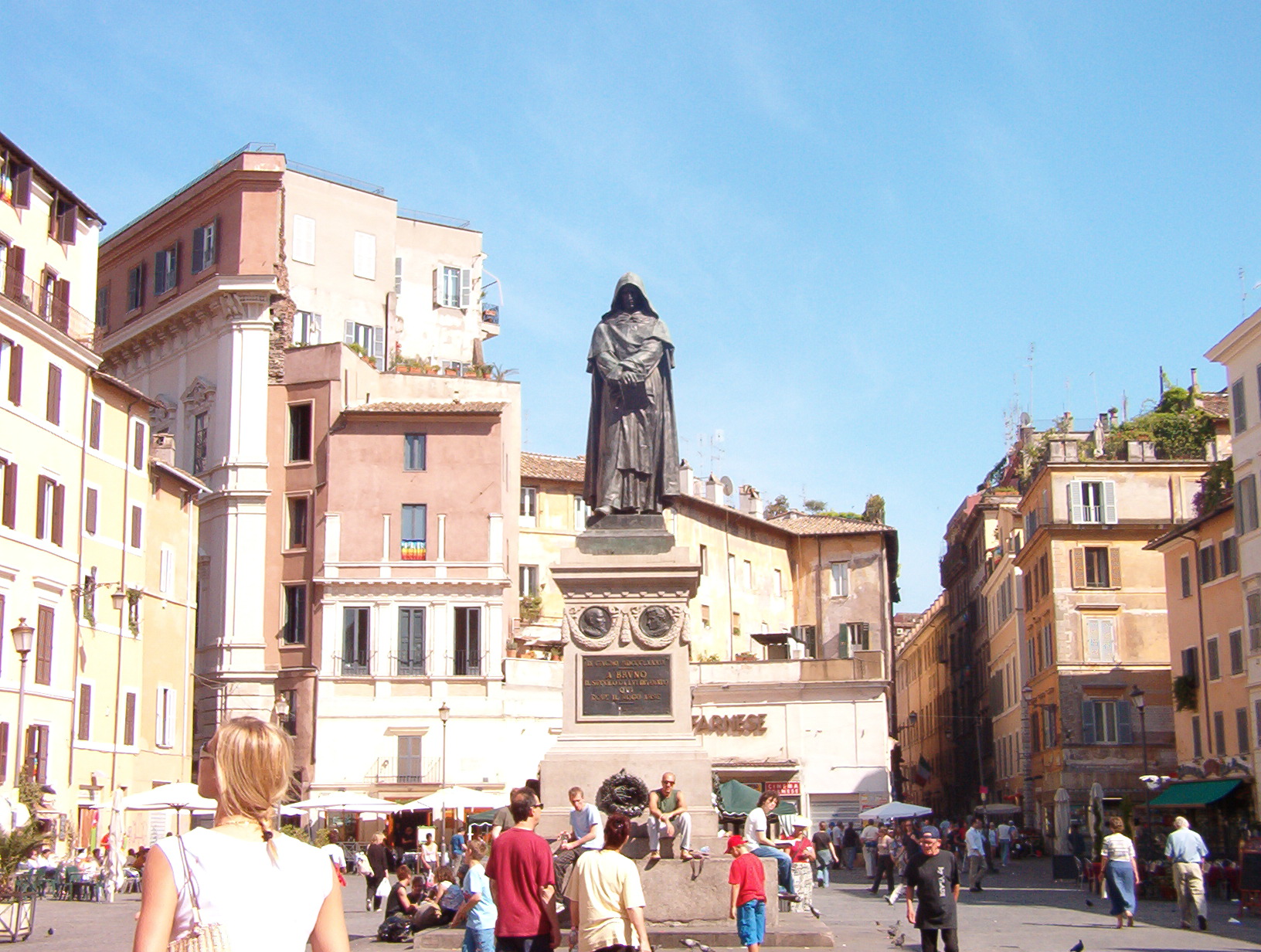 |
| A statue stands at Campo de Fiori in Rome where Bruno was burned at the stake in 1600. |
- Holding opinions contrary to the Catholic Faith and speaking against it and its ministers.
- Holding erroneous opinions about the Trinity, about Christ's divinity and Incarnation.
- Holding erroneous opinions about Christ.
- Holding erroneous opinions about Transubstantiation and Mass.
- Claiming the existence of a plurality of worlds and their eternity.
- Believing in metempsychosis and in the transmigration of the human soul into brutes.
- Dealing in magics and divination.
- Denying the Virginity of Mary (http://en.wikipedia.org/wiki/Giordano_Bruno).
2. Galileo - In 1610, the famous Italian astronomer published one of his more famous books, The Starry Messenger, in which he described some of his new-found discoveries using an improved telescope. He found mountains on the Moon, four moons of Jupiter, possibly nebulae, the phases of Venus, and the potential existence of sunspots. All of this, again like Bruno, contradicted prevailing Church and scientific beliefs (especially the idea of a permanent, unchanging perfect universe made by God). Galileo's sarcastic and very blunt style of destroying his enemies through his writing did not do him any favors, and in fact probably created more enemies or prevented people from defending him.
- By 1615, a whispering campaign had become a shout, and Galileo was summoned before the Roman Inquisition to defend himself and his beliefs. The cardinal who heard the case, Robert Bellarmine, was willing to settle for accepting Copernicus' heliocentric universe as theory but not as a physical fact, in a compromise to save Galileo. Early in 1616, the Pope and the Inquisition Board found the Copernican system to be heretical "prohibiting, condemning, or suspending various books which advocated the truth of the Copernican system" (http://en.wikipedia.org/wiki/Galileo_affair). Galileo agreed to the terms b/c he wanted to live and continue to find evidence to support his beliefs and his own personal works would not be banned.
- In 1632, new pope Urban VIII asked Galileo to publish a book discussing the heliocentric and geocentric systems but not to advocate for the heliocentric one. Galileo structured the book as a dialogue between three scientists, one for the Copernican system, one for the Aristotelian system and one who is impartial. The geocentric / Aristotelian scientist sounded like a dunce while the Copernican scientist scored points after points on the geocentric system. Galileo could have eased up in his argument, but he buried the geocentric system it - see animation link here and the problem with Mars' orbit - http://www.astro.utoronto.ca/~zhu/ast210/geocentric.html Pope Urban banned the sale of Dialogue b/c he felt that he had been portrayed as Simplico, the Aristotelian scientist, though Galileo may not have meant it that way since he and the Pope were supposed to have been friends. It's a possibility that Urban was also under fire for not going after heretics enough to the Spanish cardinals' liking, and by allowing the publication of Dialogue w/o rebuke, the Pope may have compromised himself.
In his trial in 1633, Galileo was found guilty of having promoted the Copernican system and was sentenced to house arrest for the rest of his life. Also, none of his book, past or future, would be published for the time being. Three theologians sat in judgement of him, not scientists.
Your job: you can use modern day examples, but explain why you think that science and religion either are or are not compatible with each other.
Minimum 250 words. Extended due date to Tuesday, May 10.
Sorry about the delay. This wikipedia link examines science and its compatibility with several religions.
Subscribe to:
Posts (Atom)