Review for the Hellenism, Christianity, Renaissance, and Baroque Test - Wednesday, April 19 - https://docs.google.com/document/d/1allQR65am8hNnzFvCZiehgk3qfLaSx5bKsmMobP9LmY/edit?usp=sharing
Crash Course - Anselm and Ontological Argument for God.
Crash Course - Aquinas and the Cosmological Arguments for God
Crash Course - Intelligent Design / Teleological Argument for God
Showing posts with label Galileo. Show all posts
Showing posts with label Galileo. Show all posts
Thursday, April 13, 2017


Saturday, May 7, 2011
Blog #47 - Science and Religion - Incompatible or Two Sides of the Same Coin?
I don't like making either / or arguments nor posing them so I will try to leave some wiggle room in the blog, but as we read through the cautionary tales of the scientists of the Renaissance, it makes one wonder (from a 21st Century perspective), what all the fuss was about. Just because science discovered new things did NOT mean that religion was less relavant to peoples' lives, but the Catholic Church perceived it that way, and in many ways, evolution today is that old battle in a new disguise.
Let's see what had happened to some of the Renaissance thinkers and scientists:
1. Giordano Bruno - (1548-1600) - he was an Italian friar and mathematician / astronomer who proposed that our Sun was not only at the center of our solar system (building on the work of Nicolas Copernicus) but that it was a star and that the universe was infinite. He also developed an amazing memory based upon mnemonics (word games used to remember things - HOMES for the names of the Great Lakes), but his opponents thought he used magical powers to enhance his memory. During his lifetime, he alienated and offended the clergy and prevailing scientists wherever he went by challenging Aristotelian science and many aspects of the Catholic religion including:
2. Galileo - In 1610, the famous Italian astronomer published one of his more famous books, The Starry Messenger, in which he described some of his new-found discoveries using an improved telescope. He found mountains on the Moon, four moons of Jupiter, possibly nebulae, the phases of Venus, and the potential existence of sunspots. All of this, again like Bruno, contradicted prevailing Church and scientific beliefs (especially the idea of a permanent, unchanging perfect universe made by God). Galileo's sarcastic and very blunt style of destroying his enemies through his writing did not do him any favors, and in fact probably created more enemies or prevented people from defending him.
- By 1615, a whispering campaign had become a shout, and Galileo was summoned before the Roman Inquisition to defend himself and his beliefs. The cardinal who heard the case, Robert Bellarmine, was willing to settle for accepting Copernicus' heliocentric universe as theory but not as a physical fact, in a compromise to save Galileo. Early in 1616, the Pope and the Inquisition Board found the Copernican system to be heretical "prohibiting, condemning, or suspending various books which advocated the truth of the Copernican system" (http://en.wikipedia.org/wiki/Galileo_affair). Galileo agreed to the terms b/c he wanted to live and continue to find evidence to support his beliefs and his own personal works would not be banned.
- In 1632, new pope Urban VIII asked Galileo to publish a book discussing the heliocentric and geocentric systems but not to advocate for the heliocentric one. Galileo structured the book as a dialogue between three scientists, one for the Copernican system, one for the Aristotelian system and one who is impartial. The geocentric / Aristotelian scientist sounded like a dunce while the Copernican scientist scored points after points on the geocentric system. Galileo could have eased up in his argument, but he buried the geocentric system it - see animation link here and the problem with Mars' orbit - http://www.astro.utoronto.ca/~zhu/ast210/geocentric.html Pope Urban banned the sale of Dialogue b/c he felt that he had been portrayed as Simplico, the Aristotelian scientist, though Galileo may not have meant it that way since he and the Pope were supposed to have been friends. It's a possibility that Urban was also under fire for not going after heretics enough to the Spanish cardinals' liking, and by allowing the publication of Dialogue w/o rebuke, the Pope may have compromised himself.
In his trial in 1633, Galileo was found guilty of having promoted the Copernican system and was sentenced to house arrest for the rest of his life. Also, none of his book, past or future, would be published for the time being. Three theologians sat in judgement of him, not scientists.
Your job: you can use modern day examples, but explain why you think that science and religion either are or are not compatible with each other.
Minimum 250 words. Extended due date to Tuesday, May 10.
Sorry about the delay. This wikipedia link examines science and its compatibility with several religions.
Let's see what had happened to some of the Renaissance thinkers and scientists:
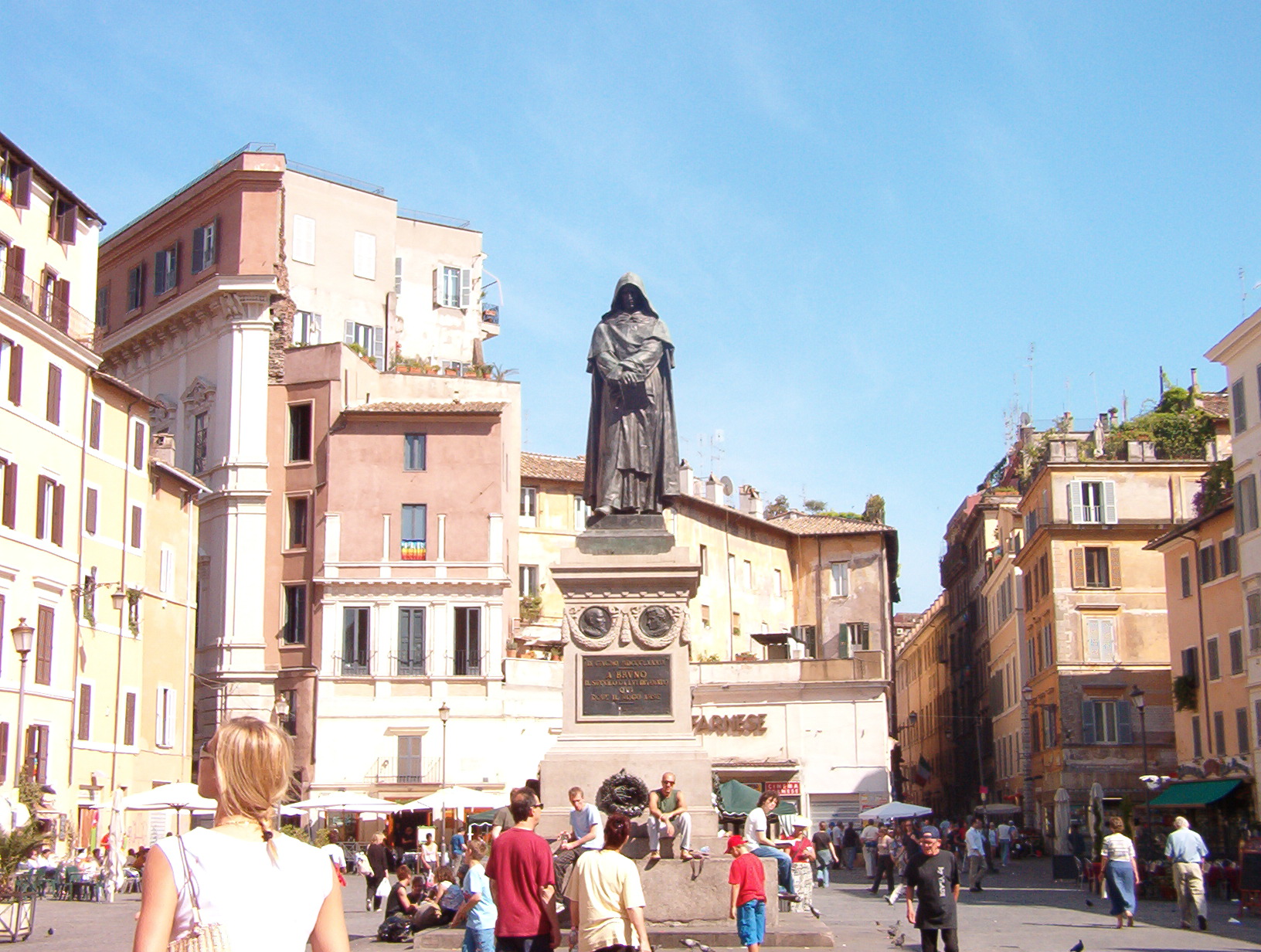 |
| A statue stands at Campo de Fiori in Rome where Bruno was burned at the stake in 1600. |
- Holding opinions contrary to the Catholic Faith and speaking against it and its ministers.
- Holding erroneous opinions about the Trinity, about Christ's divinity and Incarnation.
- Holding erroneous opinions about Christ.
- Holding erroneous opinions about Transubstantiation and Mass.
- Claiming the existence of a plurality of worlds and their eternity.
- Believing in metempsychosis and in the transmigration of the human soul into brutes.
- Dealing in magics and divination.
- Denying the Virginity of Mary (http://en.wikipedia.org/wiki/Giordano_Bruno).
2. Galileo - In 1610, the famous Italian astronomer published one of his more famous books, The Starry Messenger, in which he described some of his new-found discoveries using an improved telescope. He found mountains on the Moon, four moons of Jupiter, possibly nebulae, the phases of Venus, and the potential existence of sunspots. All of this, again like Bruno, contradicted prevailing Church and scientific beliefs (especially the idea of a permanent, unchanging perfect universe made by God). Galileo's sarcastic and very blunt style of destroying his enemies through his writing did not do him any favors, and in fact probably created more enemies or prevented people from defending him.
- By 1615, a whispering campaign had become a shout, and Galileo was summoned before the Roman Inquisition to defend himself and his beliefs. The cardinal who heard the case, Robert Bellarmine, was willing to settle for accepting Copernicus' heliocentric universe as theory but not as a physical fact, in a compromise to save Galileo. Early in 1616, the Pope and the Inquisition Board found the Copernican system to be heretical "prohibiting, condemning, or suspending various books which advocated the truth of the Copernican system" (http://en.wikipedia.org/wiki/Galileo_affair). Galileo agreed to the terms b/c he wanted to live and continue to find evidence to support his beliefs and his own personal works would not be banned.
- In 1632, new pope Urban VIII asked Galileo to publish a book discussing the heliocentric and geocentric systems but not to advocate for the heliocentric one. Galileo structured the book as a dialogue between three scientists, one for the Copernican system, one for the Aristotelian system and one who is impartial. The geocentric / Aristotelian scientist sounded like a dunce while the Copernican scientist scored points after points on the geocentric system. Galileo could have eased up in his argument, but he buried the geocentric system it - see animation link here and the problem with Mars' orbit - http://www.astro.utoronto.ca/~zhu/ast210/geocentric.html Pope Urban banned the sale of Dialogue b/c he felt that he had been portrayed as Simplico, the Aristotelian scientist, though Galileo may not have meant it that way since he and the Pope were supposed to have been friends. It's a possibility that Urban was also under fire for not going after heretics enough to the Spanish cardinals' liking, and by allowing the publication of Dialogue w/o rebuke, the Pope may have compromised himself.
In his trial in 1633, Galileo was found guilty of having promoted the Copernican system and was sentenced to house arrest for the rest of his life. Also, none of his book, past or future, would be published for the time being. Three theologians sat in judgement of him, not scientists.
Your job: you can use modern day examples, but explain why you think that science and religion either are or are not compatible with each other.
Minimum 250 words. Extended due date to Tuesday, May 10.
Sorry about the delay. This wikipedia link examines science and its compatibility with several religions.
Monday, October 12, 2009
Blog #23 - The Moral Ramifications of Scientific Discoveries
We are reading about the amazing leap of scientific discoveries during the Renaissance that take the geocentric world of Ptolemy and scramble it like an egg. After the Euro scientists Copernicus, Kepler, Galileo and Newton got through with analyzing and presenting their version of the universe (that took into account new data that had puzzled apologists for the geocentric world for years), the sun was at the center of our system and Earth was just another rock orbiting around that great big ball of light.


Galileo discovered 4 additional moons of Jupiter (1610), observed a supernova (1604), and the detailed surface of our own moon (1609) with his new and improved telescope - a discovery that shattered the idea of a universe that never changed (if scientists like Aristotle didn't find the moons or the supernova, then they shouldn't be there - forget the idea that G might have improved his telescope). Also, in 1632, his book, Dialogue Concerning the Two Chief World Systems supported the Copernican system and the not the discredited Ptolemaic system. That was enough for the Pope and the Church which had him recant his ideas and placed under house arrest for the rest of his days. 2
Kepler published his laws of planetary motion in 1609 that were consistent with the Copernican system (The Roman Catholic Church kept fighting these new discoveries and stuck to their guns, while some new Protestant churches accepted these new scientific findings, so the science took on a whole other political / religious dimension). Kepler also supported Galileo as well but was soon caught up in the poltical battles in Germany and Austria and lost his post in 1630.
Isaac Newton came up with his laws for gravity and motion that not only tied all of this together but did it with the simplicity of math - he used the math to show that this new Copernican interpretation was God's intention all along. He synthesized Copernicus, Galileo, and Kepler and tied it all together in one neat system that in many ways still stands up today. 3
After all of this, however, I was wondering about the moral ramifications of a scientist's discoveries. In this case, these men upset the natural order of the known scientific world. As we'll read later, Darwin will knock mankind from his pedastal w/ his Origin of Species in 1859. Then later Einstein will usher in the age of relativism w/ his theory of relativity (historian Paul Johnson asserted that this theory blew down the boundaries of right and wrong and made EVERYTHING relative - you don't have to agree w/ him; it's his theory). After that, we had nuclear bombs and germ (bio) and chemical warfare available for use.
Questions:
2. If you discovered something potentially dangerous or blasphemous, how would you handle it? Would you pull a Copernicus and publish posthumously (after death)? Would you release the results and try to protect and defend the discovery like Galileo and Kepler? Or is there another alternative?
150 words minimum - Due Tuesday, October 13.

2. The Galileo Project - Rice University - http://galileo.rice.edu/index.html
Copernicus didn't publish his book - and this is in dispute - Sophie's World says in fear of disrupting the natural order of the world. Other places I've looked say that he was a bit of a perfectionist and he wanted his data squared away with his conclusions. The following website states why his findings were a bit disconcerting to the Middle Aged mind:
"Man, it was believed (and still believed by some) was made by
God in His image, man was the next thing to God, and, as such, superior,
especially in his best part, his soul, to all creatures, indeed this part was
not even part of the natural world (a philosophy which has proved disastrous to
the earth's environment as any casual observer of the 20th century might confirm
by simply looking about). Copernicus' theories might well lead men to think that
they are simply part of nature and not superior to it and that ran counter to
the theories of the politically powerful churchmen of the time."
1

So what if we lived on a planet that rotated around the sun instead of the other way around? Well, that was just the beginning. Italian scientist Giordano Bruno took it a step (or five) further by suggesting that space is infinite and that our solar system might just be one of many systems out there in space, and .... (wait for it)...there might be life on other planets! For this leap of logic, he was burned at the stake by the Inquisition (don't we have the cable news networks for that today?).

Galileo discovered 4 additional moons of Jupiter (1610), observed a supernova (1604), and the detailed surface of our own moon (1609) with his new and improved telescope - a discovery that shattered the idea of a universe that never changed (if scientists like Aristotle didn't find the moons or the supernova, then they shouldn't be there - forget the idea that G might have improved his telescope). Also, in 1632, his book, Dialogue Concerning the Two Chief World Systems supported the Copernican system and the not the discredited Ptolemaic system. That was enough for the Pope and the Church which had him recant his ideas and placed under house arrest for the rest of his days. 2
Kepler published his laws of planetary motion in 1609 that were consistent with the Copernican system (The Roman Catholic Church kept fighting these new discoveries and stuck to their guns, while some new Protestant churches accepted these new scientific findings, so the science took on a whole other political / religious dimension). Kepler also supported Galileo as well but was soon caught up in the poltical battles in Germany and Austria and lost his post in 1630.
Isaac Newton came up with his laws for gravity and motion that not only tied all of this together but did it with the simplicity of math - he used the math to show that this new Copernican interpretation was God's intention all along. He synthesized Copernicus, Galileo, and Kepler and tied it all together in one neat system that in many ways still stands up today. 3
After all of this, however, I was wondering about the moral ramifications of a scientist's discoveries. In this case, these men upset the natural order of the known scientific world. As we'll read later, Darwin will knock mankind from his pedastal w/ his Origin of Species in 1859. Then later Einstein will usher in the age of relativism w/ his theory of relativity (historian Paul Johnson asserted that this theory blew down the boundaries of right and wrong and made EVERYTHING relative - you don't have to agree w/ him; it's his theory). After that, we had nuclear bombs and germ (bio) and chemical warfare available for use.
Questions:
1. Is he or she (scientist or discoverer) responsible for the ways that their discovery is used / abused? Why or why not? What are the implications of holding someone accountable for their invention?
2. If you discovered something potentially dangerous or blasphemous, how would you handle it? Would you pull a Copernicus and publish posthumously (after death)? Would you release the results and try to protect and defend the discovery like Galileo and Kepler? Or is there another alternative?
150 words minimum - Due Tuesday, October 13.

2. The Galileo Project - Rice University - http://galileo.rice.edu/index.html
I would like to recommend a very readable book about this tumultuous period - it has the science but it isn't overwhelmingly technical. It's Galileo's Daughter by Dava Sobel. Good stuff!
Sunday, January 18, 2009
Blog #13 - Galileo's Paradigm Shift - What would be our next one?
There have been three paradigm shifts within the past four hundred years or so that have altered man's image of itself forever. Galileo's refinement of the telescope and discovery of Jupiter's four moons (this discovery and others like it helped reinforce the new heliocentered universe but wait! I thought the Earth was unalterable from creation - no one said anything about moons around Jupiter), Darwin's concept of evolution (refuting the idea that man is NOT made in God's image), and Freud's psychological theories about our unconscious desires controlling us (who's really in control?).


 My question is: what kind of FUTURE paradigm shift do you envision shaking up life as we know it? (cue R.E.M.'s "It's the End of the World As We Know It"). What kind of technological innovation could revolutionize our lives in the near future? What kind of scientific breakthrough or discovery could alter the course of our lives? Could an accident or a terrorist attack or unforeseen event forever change the world?

What is a paradigm shift? - This is a term initially defined by Thomas Kuhn (Wikipedia) in 1962 to describe a realignment in the basic thinking or assumptions about a topic. For instance, when movies went from silent to talkies in 1927 with The Jazz Singer, that made a whole new kind of movie possible for future directors. Kuhn initially applied the term to science, but since then, it has been adapted to many different things since 1962.

By way of illustrating this, the way people conduct research nowadays is completely different than it was when I did my undergrad degree at MSU less than 20 years ago. Computers existed back then but mainly as word processors (like the fabulous Apple IIe pictured to the right); the internet also existed but not in its current incarnation. When I needed to do research on a topic, I went to the library and looked up stuff the old fashioned way: I found the info in a card catalog in a long wooden shelving unit that smelled of mildew. I wrote down a whole list of books / articles / etc. and then I went and found them on the shelves in the library; if they were there, I looked to see that the books / articles / etc. had something relevant in it about my topic. If not, it went back on the shelf. If so, it went in my backpack. When my backpack got too full, I stopped at the nearest study table and started either taking notes on the relevant info or made copies of said info (if I had enough $$). Sound like fun? Just writing that and remembering that whole process made me thankful for computers.
By the time my Master's thesis came along in 1996-97, I still did some of the searching in the Wayne State library. But, most of the grunt work (card catalog searches, humping up and down stairs, checking out book shelves) was done by ERIC, an educational search engine. I had also upgraded to a Windows 95 computer and could surf the net in its infancy. A paradigm shift had occurred in research - how it was conducted, how quickly and efficiently it could be done. But the evaluation still had to be done by a human.
 My question is: what kind of FUTURE paradigm shift do you envision shaking up life as we know it? (cue R.E.M.'s "It's the End of the World As We Know It"). What kind of technological innovation could revolutionize our lives in the near future? What kind of scientific breakthrough or discovery could alter the course of our lives? Could an accident or a terrorist attack or unforeseen event forever change the world?
Take some time to think about what you think might change our lives like Darwin, Galileo and Freud had done.
Due Wednesday, January 21st. 250 words minimum (should take some deep thinking).
Subscribe to:
Posts (Atom)