Showing posts with label Charles Darwin. Show all posts

Tuesday, May 14, 2019

Blog #85 - In Time

"For a few immortals to live, many people must die."

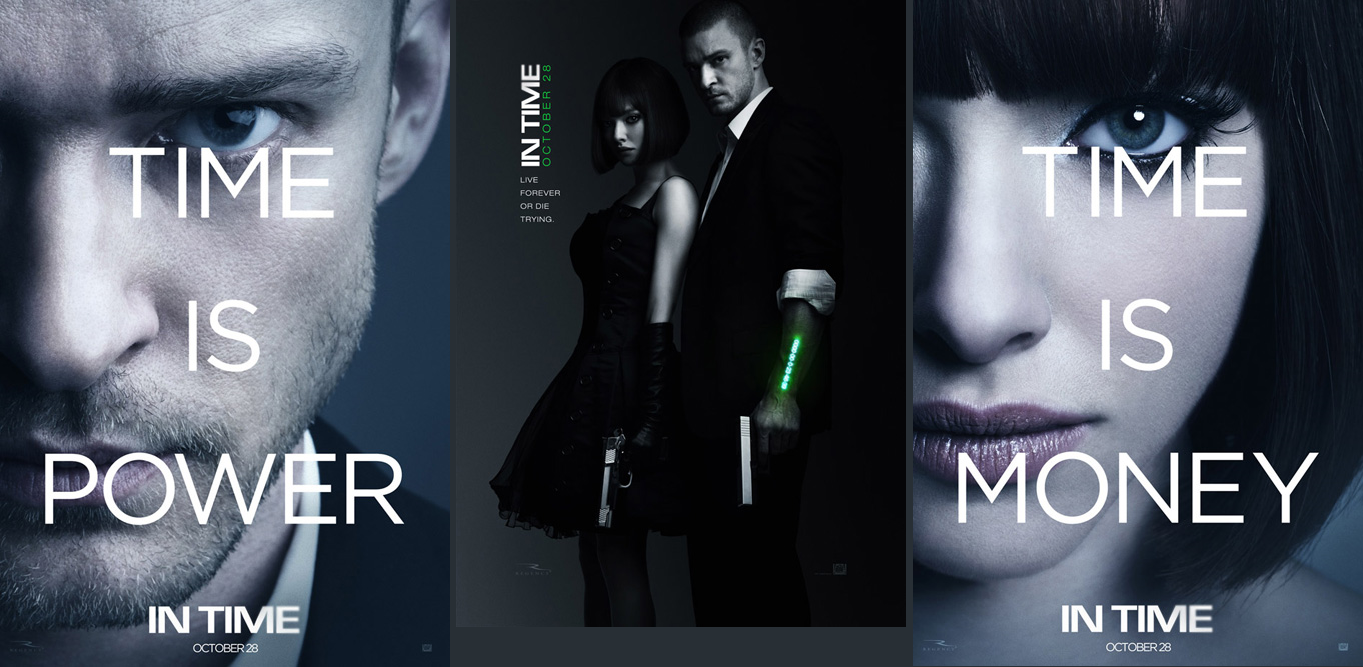
Image result for In time movie

We are presented with a future world in the movie, In Time, in which time has become so precious that it has now become currency.  Somehow, our bodies are born (or implanted with a device) that begins ticking when we reach the age of 25 so that those who work get paid in time and have to buy their necessities like food and rent using the currency of time. 

There are also time zones (don't think like what we have -Eastern, Central, etc., but different parts of a larger city), segregated communities that you must pay time to get into.  Just think of gated cities within a much larger city - this is a way to keep the very poor out of (what can only be assumed to be) a middle class or upper class time zone, because the more Will pays as he heads towards the wealthiest part of town, the price continues to go up.  So, in essence, there still is free passage among the city, but only if you can afford it.  But since many can't afford it, the poor are stuck in their slums. 

The movie focuses most of its time on poor characters who are working day-to-day and struggling to survive.  When wages go up, the prices of goods go up, so there's no real way for the poor to get ahead.     And of course, in such a dog-eat-dog world, there are also gangsters who try to steal peoples' time - the Minutemen.  And when the clock runs out on someone, he/she is dead.  Even the timekeepers, the police of this dystopian society, are barely paid decent wages in order to stay alive.  Sadly ironic, the ones that are entrusted with enforcing the system don't get paid enough (sounds familiar).  In addition, the police are interested in the suicide of one wealthy man yet there are tons of murders in the ghetto everyday.  Where does this society's priorities truly lie?  In the preservation of the monopoly of time by one particular class.  


The rich, on the other hand, are trapped in a different kind of gilded prison (think of why Henry gve Will almost all of his time before he died and let his clock expire).  Philipe Weis thinks that this time as currency thing is just the next step in evolution - that it is unfair, he says, but so is evolution.  With decades, even centuries on their clocks, they continue to look the same as they did when they were 25 even though they might be 107.  The one creepy Freudian thing is when Phillipe Weis introduced his mother, wife and daughter (Sylvia) who all looked very similar.  Sylvia and Will hit it off and that's when Sylvia said that all the wealthy needed to do was stay out of trouble and they could live forever.  Play it safe = live forever.  So, unlike Will who lives by the phrase, "Carpe Diem", Sylvia never took chances until she met Will. 

Your job for this blog is to 1. apply at least one philosopher or philosophic concept to any part or parts of this movie that you find apply to this movie.  2. Find a weakness in the movie, whether it be in the plot, concept, etc. and explain why.  3. Tie in the Through the Wormhole episode we saw w/ the movie and any of the concepts introduced in the episode.  If you missed the episode, get some notes from one of your classmates.  

Due Friday, May 17 by class.  350 words total for your response.  

Friday, February 13, 2009

Reading Assignments for the rest of the semester

Here's the semester's HW list.

Enlightenment for Monday 2/9

Romanticism for Wednesday 2/11

Blog #15 2/12

Kierkegaard for Friday 2/13 + fill in the blank notes.

Over break, read Marx and Darwin + read Newsweek Darwin article and answer questions.
http://www.newsweek.com/id/51285
Questions are due on Monday you get back, 2/23.

If you look at the class’s website or go to previous blog posts, you’ll see both of these either posted or links to them.

Freud for Wednesday 2/25

Our Own Time for Friday 2/27

Garden Party for Monday 3/2

Quiz on Tuesday, 3/3.

3rd Hour exam Thursday 3/5
4th Hour exam Friday 3/6
Review session Tuesday, 7:45 a.m. and Wednesday 2:50 p.m.

Sunday, January 18, 2009

Blog #13 - Galileo's Paradigm Shift - What would be our next one?

There have been three paradigm shifts within the past four hundred years or so that have altered man's image of itself forever. Galileo's refinement of the telescope and discovery of Jupiter's four moons (this discovery and others like it helped reinforce the new heliocentered universe but wait! I thought the Earth was unalterable from creation - no one said anything about moons around Jupiter), Darwin's concept of evolution (refuting the idea that man is NOT made in God's image), and Freud's psychological theories about our unconscious desires controlling us (who's really in control?).


What is a paradigm shift? - This is a term initially defined by Thomas Kuhn (Wikipedia) in 1962 to describe a realignment in the basic thinking or assumptions about a topic. For instance, when movies went from silent to talkies in 1927 with The Jazz Singer, that made a whole new kind of movie possible for future directors. Kuhn initially applied the term to science, but since then, it has been adapted to many different things since 1962.


By way of illustrating this, the way people conduct research nowadays is completely different than it was when I did my undergrad degree at MSU less than 20 years ago. Computers existed back then but mainly as word processors (like the fabulous Apple IIe pictured to the right); the internet also existed but not in its current incarnation. When I needed to do research on a topic, I went to the library and looked up stuff the old fashioned way: I found the info in a card catalog in a long wooden shelving unit that smelled of mildew. I wrote down a whole list of books / articles / etc. and then I went and found them on the shelves in the library; if they were there, I looked to see that the books / articles / etc. had something relevant in it about my topic. If not, it went back on the shelf. If so, it went in my backpack. When my backpack got too full, I stopped at the nearest study table and started either taking notes on the relevant info or made copies of said info (if I had enough $$). Sound like fun? Just writing that and remembering that whole process made me thankful for computers.

By the time my Master's thesis came along in 1996-97, I still did some of the searching in the Wayne State library. But, most of the grunt work (card catalog searches, humping up and down stairs, checking out book shelves) was done by ERIC, an educational search engine. I had also upgraded to a Windows 95 computer and could surf the net in its infancy. A paradigm shift had occurred in research - how it was conducted, how quickly and efficiently it could be done. But the evaluation still had to be done by a human.

My question is: what kind of FUTURE paradigm shift do you envision shaking up life as we know it? (cue R.E.M.'s "It's the End of the World As We Know It"). What kind of technological innovation could revolutionize our lives in the near future? What kind of scientific breakthrough or discovery could alter the course of our lives? Could an accident or a terrorist attack or unforeseen event forever change the world?


Take some time to think about what you think might change our lives like Darwin, Galileo and Freud had done.


Due Wednesday, January 21st. 250 words minimum (should take some deep thinking).

Tuesday, November 11, 2008

Darwin article link and questions

Hey folks,
Here's a link to the Darwin article - http://www.newsweek.com/id/51528 and the questions in case ya lost the silly thing.

Please answer 7 of the 11 questions below. (Please include the bold questions as part of your seven).
1. Why do you think evolution’s opponents use the term “Darwinism” instead of evolution?
2. Why did Charles Darwin finally publish The Origin of Species in 1859?
3. Provide at least two possible reasons for Darwin’s intestinal distress and heart palpitations during this time period with explanations.
4. Why was Darwin’s evidence so important in proving his theory?
5. How did the glyptodont fossil help with Darwin’s theory?
6. What was Charles Darwin’s more radical achievement, according to the article?
7. How did Thomas Malthus fit into Charles Darwin’s ideas?
8. What was the great implication for mankind in Darwin’s new book, The Descent of Man, published in 1871?
9. How did Darwin describe his own religious beliefs?
10. When did he first start doubting?
11. The article quotes a believer as saying that “suffering is ‘ennobling, an agent of moral improvement.’” Darwin’s favorite daughter, 10-year old Annie, died from TB in 1851, led him into some very dark places. Do you agree or disagree with this argument about suffering? Why or why not? Feel free to use a personal example.

Due Thursday, November 13, 2008


Another neat article by Newsweek: How Lincoln and Darwin have influenced our thoughts: http://www.newsweek.com/id/143742?tid=relatedcl