Monday, May 16, 2011

Blog #48 - Interpretations of Inception


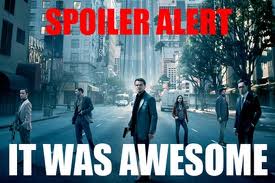
I am glad that we watched Inception together as a class because our discussions afterwards confirmed my initial feelings about the movie when I saw it last summer - that this was a movie that could be like The Matrix and be both entertaining and work on several different levels of philosophical interpretation. I'm going to toss out a bunch of questions for you to consider, and please pick two to answer before Tuesday's class.


Questions to choose from (pick two):

1. Near the end, Mal (or her projection) in limbo makes a pretty good case that Cobb is lost in his own dream and can't tell one reality from another. Do you think that this is a plausible alternative?  Why or why not? 


2. This blog from Moviefone.com outlines six different interpretations of the film (and also five plot holes - see next question). Read it for more details on each of the six interpretations, but I'll just list each of them below. We have talked about some of them in class.

** If you decide to tackle more than one interpretation of Inception, this will count as your two questions.

a. All of Inception is a dream - are we ever really shown reality? Whose dream is it, anyway?

b. Everything after the test sedation is a dream - after Yusuf's chemical test, do we see Cobb spin his totem and see it fall properly?

c. Saito is the architect and pulls a Mr. Charles gambit on Cobb - instead of a job audition like Saito said, maybe Saito is trying to extract something from Cobb?

d. Ariadne is Cobb's therapist trying to help him get over Mal's death - This is an interesting and plausible take on the movie - found here http://halphillips.tumblr.com/post/822919795/inception

e. We do see reality in the movie (first train ride in Japan, Paris, Mombasa), but Cobb is in a dream at the end - could this explain why the totem never falls at the end of the movie? This interpretation apparently hinges on the idea that the children don't appear to have aged. Plus, we don't see how Saito and Cobb get out of limbo.

f. What we see is what we get - that we are presented with a reality at the beginning of the movie (train ride in Japan) and that Cobb is back in the U.S. at the end of the movie.


3. What do you think were the movie's biggest plot holes? We had discussed a few, and I wasn't satisfied with a couple of the answers - which sounded like filmmakers' excuses instead of decent rationales. Provide one or two examples (you might want to read the blog link mentioned at the beginning of question #2 to help you out if you forgot) and explain how these holes do or don't affect the movie.


4. Evil genius theory - we had discussed this in class and it didn't get much traction, but I wonder if it's possible to show that either Saito, Mal or Cobb could be the evil genius manipulating everything we're seeing. Or could it be the film maker Christopher Nolan?


5. Is Inception really just an extended metaphor for films? In a previous blog from last semester, I posted a link from Wired, and I traced it back to its source, so I'll quote the author's take on Nolan's film:
"The film is a metaphor for the way that Nolan as a director works, and what he’s ultimately saying is that the catharsis found in a dream is as real as the catharsis found in a movie is as real as the catharsis found in life. Inception is about making movies, and cinema is the shared dream that truly interests the director."

Here's a link to the whole post: http://www.chud.com/24477/NEVER-WAKE-UP-THE-MEANING-AND-SECRET-OF-INCEPTION/


My question is, do you buy this interpretation of the movie? Why or why not? What kind of implication does it have for us as film watchers - this shared "dream space" of watching a movie together? Did Christopher Nolan just perform inception on all of us because it's now an idea, like a parasite that won't go away? :)


6. Comparing the dream/reality rules in Inception and (if you've seen) The Matrix, why do you think they're vastly different? How does Descartes' dualistic theory about the mind and body being separated work for one movie but not the other?


7. When Saito asks Cobb to take a leap of faith, he's asking Cobb to believe in him and Saito's ability to fix Cobb's problems. In some ways, Saito almost acts like a deity in this movie because through him, almost everything is engineered to work. He is the Prime Mover or causal agent - Cobb and his team are sent on their mission because they failed to extract vital info from Saito for Cobol Engineering. They are tasked to help destroy Saito's biggest competitor (Fischer), and when it's all said and done, Saito returns from limbo after many many years (remember, Mal and Cobb didn't look like they had aged when the train ran them over after just 50 yrs together, but Saito was wrinkled and withered) and supposedly sweeps away Cobb's murder warrant. What is Saito, really? Is he just a very powerful man or is he something else? Why?


8. Those of you with AP Psych experience, help us out on some of the brain / dream logistics. The way that they explain the dream rules in the movie sound plausible, but what is realistic w/ regards to dreams? Shared dream space isn't possible, is it? Any other psych insights would be greatly appreciated here.


9. Arthur mentioned it briefly on how the technology for the shared dreaming was created - by the military so that soldiers could fight/kill each other without truly maiming themselves in reality. Plus, the character played by Michael Caine, Mal's father, seems to have been the one who taught Cobb how to do what he could do. In many ways, I sense the hints of a "prequel," not a sequel for this movie. Unlike the Matrix (which probably should have been left alone instead of having 2 sequels), it might be interesting to explore how the technology for this type of thing was developed and most likely stolen. If it takes 10 years in between movies like it did with Toy Story or Tron, then so be it. What kinds of possibilities do you see in a prequel or, even if you don't agree with me, a sequel?


Some additional points and counterpoints to theories in the movie - http://inceptiontheories.com/inception-theories-points-counterpoints/

Blog #48 will be due Tuesday, 5/17. 150 words for each answer, 300 words total.

Saturday, May 7, 2011

Blog #47 - Science and Religion - Incompatible or Two Sides of the Same Coin?

I don't like making either / or arguments nor posing them so I will try to leave some wiggle room in the blog, but as we read through the cautionary tales of the scientists of the Renaissance, it makes one wonder (from a 21st Century perspective), what all the fuss was about.  Just because science discovered new things did NOT mean that religion was less relavant to peoples' lives, but the Catholic Church perceived it that way, and in many ways, evolution today is that old battle in a new disguise. 

Let's see what had happened to some of the Renaissance thinkers and scientists:

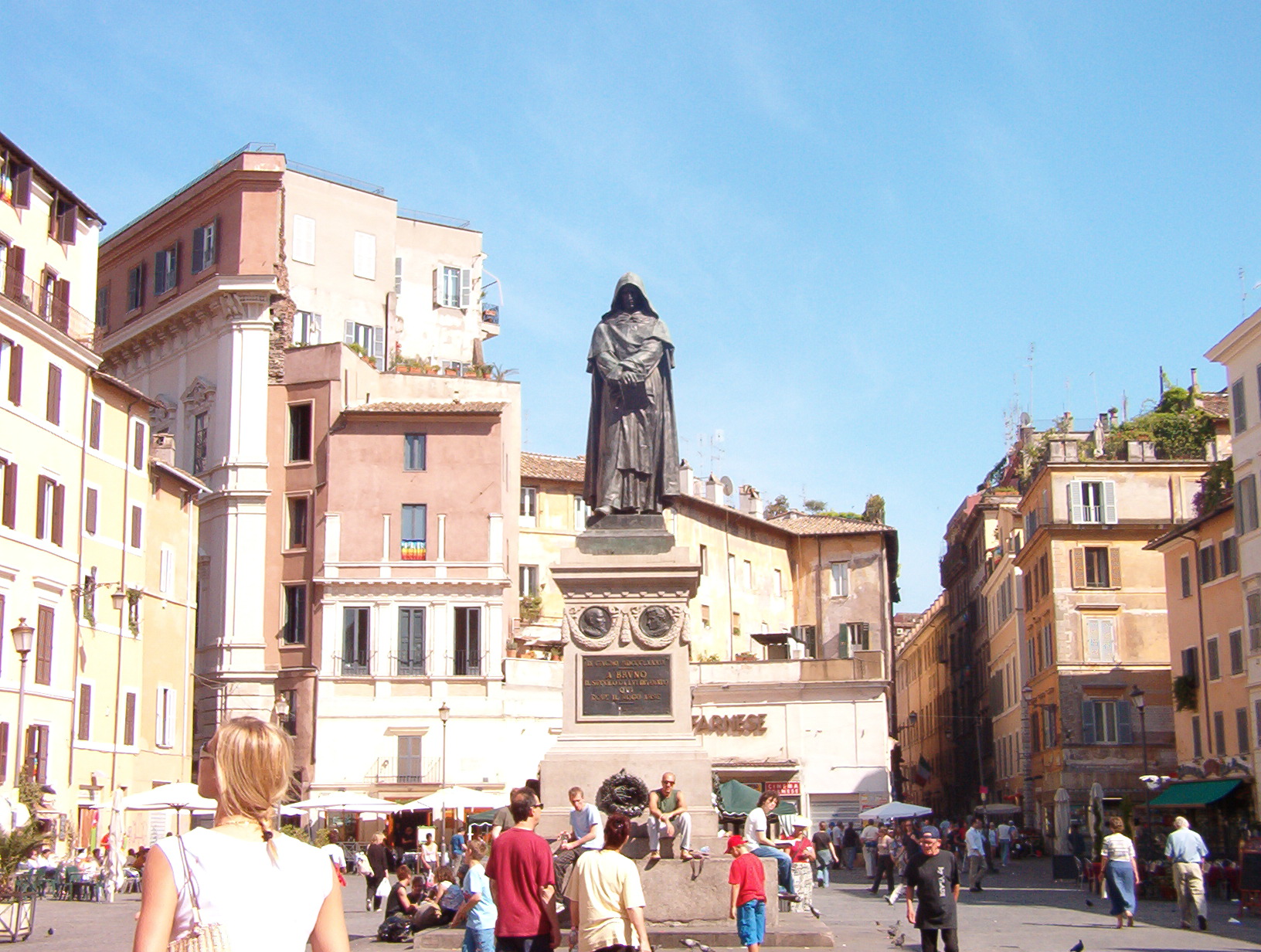
File:Brunostatue.jpg
A statue stands at Campo de Fiori in Rome where
Bruno was burned at the stake in 1600. 
 1. Giordano Bruno - (1548-1600) - he was an Italian friar and mathematician / astronomer who proposed that our Sun was not only at the center of our solar system (building on the work of Nicolas Copernicus) but that it was a star and that the universe was infinite.  He also developed an amazing memory based upon mnemonics (word games used to remember things - HOMES for the names of the Great Lakes), but his opponents thought he used magical powers to enhance his memory.   During his lifetime, he alienated and offended the clergy and prevailing scientists wherever he went by challenging Aristotelian science and many aspects of the Catholic religion including:
  • Holding opinions contrary to the Catholic Faith and speaking against it and its ministers.
  • Holding erroneous opinions about the Trinity, about Christ's divinity and Incarnation.
  • Holding erroneous opinions about Christ.
  • Holding erroneous opinions about Transubstantiation and Mass.
  • Claiming the existence of a plurality of worlds and their eternity.
  • Believing in metempsychosis and in the transmigration of the human soul into brutes.
  • Dealing in magics and divination.
  • Denying the Virginity of Mary (http://en.wikipedia.org/wiki/Giordano_Bruno).
The Vatican and other historians debate whether Bruno was killed b/c of his scientific beliefs or his contrary beliefs in the Catholic Church.  Looking at the list above, it's safe to say that he questioned just about everything that was divine within the religion (if these charges are true). 

2. Galileo - In 1610, the famous Italian astronomer published one of his more famous books, The Starry Messenger, in which he described some of his new-found discoveries using an improved telescope.  He found mountains on the Moon, four moons of Jupiter, possibly nebulae, the phases of Venus, and the potential existence of sunspots.  All of this, again like Bruno, contradicted prevailing Church and scientific beliefs (especially the idea of a permanent, unchanging perfect universe made by God).   Galileo's sarcastic and very blunt style of destroying his enemies through his writing did not do him any favors, and in fact probably created more enemies or prevented people from defending him. 
  - By 1615, a whispering campaign had become a shout, and Galileo was summoned before the Roman Inquisition to defend himself and his beliefs.  The cardinal who heard the case, Robert Bellarmine, was willing to settle for accepting Copernicus' heliocentric universe as theory but not as a physical fact, in a compromise to save Galileo.  Early in 1616, the Pope and the Inquisition Board found the Copernican system to be heretical "prohibiting, condemning, or suspending various books which advocated the truth of the Copernican system" (http://en.wikipedia.org/wiki/Galileo_affair).  Galileo agreed to the terms b/c he wanted to live and continue to find evidence to support his beliefs and his own personal works would not be banned. 
 - In 1632, new pope Urban VIII asked Galileo to publish a book discussing the heliocentric and geocentric systems but not to advocate for the heliocentric one.  Galileo structured the book as a dialogue between three scientists, one for the Copernican system, one for the Aristotelian system and one who is impartial.  The geocentric / Aristotelian scientist sounded like a dunce while the Copernican scientist scored points after points on the geocentric system.  Galileo could have eased up in his argument, but he buried the geocentric system it - see animation link here and the problem with Mars' orbit - http://www.astro.utoronto.ca/~zhu/ast210/geocentric.html  Pope Urban banned the sale of Dialogue b/c he felt that he had been portrayed as Simplico, the Aristotelian scientist, though Galileo may not have meant it that way since he and the Pope were supposed to have been friends.  It's a possibility that Urban was also under fire for not going after heretics enough to the Spanish cardinals' liking, and by allowing the publication of Dialogue w/o rebuke, the Pope may have compromised himself. 

In his trial in 1633, Galileo was found guilty of having promoted the Copernican system and was sentenced to house arrest for the rest of his life.  Also, none of his book, past or future, would be published for the time being.  Three theologians sat in judgement of him, not scientists. 

Your job:  you can use modern day examples, but explain why you think that science and religion either are or are not compatible with each other

Minimum 250 words.  Extended due date to Tuesday, May 10.

Sorry about the delay.  This wikipedia link examines science and its compatibility with several religions. 

Sunday, April 24, 2011

Blog #46 - Hellenism today


I kept wondering how Hellenistic philosophy applied to today's world as we briefly discussed it on Wednesday.  I didn't have a lot of time to really go in depth with it, so I included summaries and bumper sticker slogans that could apply, but I still didn't feel like it was enough.  So, I thought, why not dig into this school of thought on the blog?

First, Epicureans - as we explore most philosophy (and most likely religions as well), there seems to be a denial of pleasure or the association that pleasure is at best, a necessary evil. The philosopher, Epicurus, said that the "best sort of life...is one that is free from pain in the body and from disturbance in the mind. That sounds a rather negative credo for a 21st-century devotee of the good life."  There are so many pleasures out there in life that we have been told to stay away from or "wait until you're older."  And, in fact, Epicurus "condemned all forms of over-indulgence, and recommended a simple diet."  But, as you become an adult and temptations increase, where do you draw the line?  Was Epicurus right to withdraw into his garden with friends and live a simple life of pleasure?  How can that work in today's fast-paced, interconnected society?  Do you pull a Henry David Thoreau on everyone and go to live in the woods, simply?  Or is there something in between completing dropping out and total hedonism?

I found an interesting article online: "Epicurus Exonerated": http://moreintelligentlife.com/story/epicurus-exonerated  All the quotes above are from this article. 


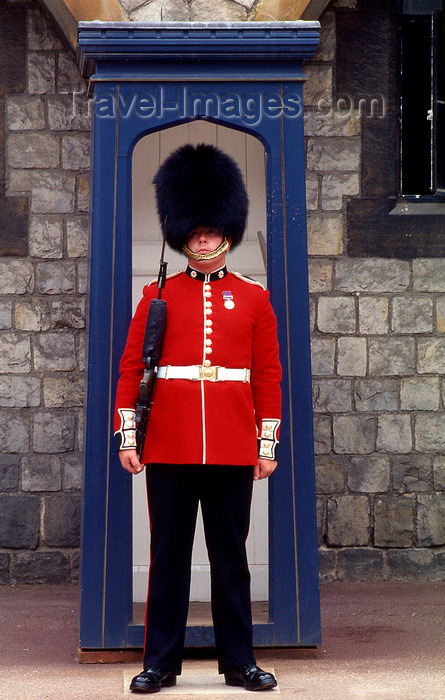
Stoicism - When I think of this, I mentioned the British palace guards who tourists like to mess with and try to get them to smile.  But stoicism is much more than that, especially when dealing with such an uncertain, violent world.  This particular quote from Marcus Aurelius, one of the last great Roman emperors, could fit perfectly in our time period:

“I shall meet today ungrateful, violent, treacherous, envious, uncharitable men. All of these things have come upon them through ignorance of real good and ill… I can neither be harmed by any of them, for no man will involve me in wrong, nor can I be angry with my kinsman…” - Marcus Aurelius


Stoicism doesn't mean standing idly by while crazy stuff happens.  I think, in many ways, it has to do with the ways in which you react (or don't react) to all the sensationalist news, Chicken-Littles, and Boys-Who-Cried-Wolf out there in the media.  If we believed everything we saw and heard about our world that's dangerous, we'd never get our kids immunized for fear of them getting autism, we'd never buy certain brands of products b/c of an email circulating the globe about the product's danger, and we'd certainly never leave the house. 

This article, "The Modern Wimp's Introduction to Stoicism", is rather crude but funny and tries to dispel the notion that being stoic means not flinching when boys get punched in the groin: http://www.primermagazine.com/2010/live/introduction-to-stoicism 

This article talks about how to be stoic: http://www.stoics.fsnet.co.uk/#BeStoical 

 - However, do we ignore all of the warnings out there about impending doom?  Too many people ignored the oncoming freight train of death that was attached to the subprime mortgage bubble, and you see where that got us in 2008.  Too many people were busy making too much money to listen to the Pollyannas saying, "hold on a minute!"  And sometimes, sifting through the town crier's messages, isn't there just the call for moderation?  If global warming isn't happening exactly as Al Gore said it would, what's wrong with cutting back on our dependence on foreign oil and driving more fuel-efficient cars?  What's wrong with getting involved more with the 3 Rs - recycle, reuse, and reduce?  I don't know who is correct in the global warming debate, nor do I care, but there can't be anything wrong w/ America reducing its carbon footprint. 

Cynics - the ancient Greeks who followed this school of thought often rejcted materialism and strove to live life simply. Cynics today, however, at least the word cynic, generally dismiss peoples' good intentions as having ulterior motives. There is a strain of persistent disbelief and irrational thought that can lie in the cynical outlook today. With the number of politicians and celebrities that have lied to us while embracing the opposite of what they hold dear, while corporations say one thing and do the other, and our government fails to follow through on its promises, it's no wonder Americans didn't become full blown cynics before the Vietnam War and Watergate in the 1960s and 70s.


 - Has cynicism led to an unhealthy belief in conspiracy theories?  When common sense or persistent, reasoned questioing can poke holes in most of the conspiracies almost immediately, why do they still continue to stay alive?  Should we believe in our politicians and leaders and their promises, or just expect them to let us down again? 

 
Some comments in this paragraph come from: http://www.wisegeek.com/what-is-cynicism.htm


Skeptics - this school is probably the most easily applicable to today's world because of our almost religious belief in modern science, which practically demands a skeptical viewpoint of the world.  And in many ways, having a healthy skepticism is helpful for a scientist, philosopher, and in general, being an intelligent human being with all the flood of bogus news out there. 

Where skepticism differs from cynics is that with cynics, you've already lost before the battle has begun.  You will not be able to convince your opponent, rhetorical or otherwise, of any good intentions, etc.  If you win, the cynic will probably claim that the game was rigged, and if they win, you weren't a worthy opponent.

I believe that a healthy skepticism in today's life means many things, but I find it hard to explain it w/o resorting to cliches.  "I'll see it when I believe it."   "Proof is in the pudding." 

Craig Damrauer's print from "Modern Art" which
I think sums up the art cynic in all of us.
However, I always leave room for belief if something has been proven correct.  This can extend to just about anything in my life.  I sometimes fear that skeptics have been cast as those who don't believe in anything, and maybe that is where the confusion lies w/ cynicism. 


Your job: Pick one of the four Hellenist schools of thought and explain in 250 words or more how it applies to your life.  If you're having trouble just sticking to one school of thought, or you take issue with something I've said here, then by all means, jump into the fray! 

Due Wednesday, April 27 before class begins

Tuesday, April 12, 2011

Blog #45 - Fate - Fight / Accept / Avoid / Change it?

In the episode of The Unusuals, "42" that we watched in class, the whole show revolves around fate and the random (or not-so-random) ways in which our choices affect the casts' lives.   Even from the opening sequence when bad guy Frank Lutz attempts to kill Detective Walsh, a stray bullet catches Detective Allison Beaumont in the stomach (maybe to show how forces beyond our control affect us too - determinism or chaos theory?)  


We saw how Detective Leo Banks deals with his perceived fate (to die at 42 b/c of his family members who had done so). As a foil to Detective Banks, there was the psychic who wholeheartedly embraced her fate and did just about everything she could to meet it with open arms. 


On the other hand, Detective Henry Cole has moved away from his criminal past and reinvented himself as a religious young man and police officer. His former accomplice on the armored car heist, Frank Lutz, appears to be very jealous of Cole's transformation and demands that Cole pay some sort of restitution for this, almost like the Devil demanding his due. In the end, detectives Schraeger and Walsh cover for Cole, and Lutz ends up dead.  In essence, they approve of Cole's new life by not turning him in.


And in a superstitious way, Banks, Walsh and Delahoy refused to go into the hospital for various reasons. But, it could all be just a way of avoiding the ever-present danger of death prevelant in their job.


If you missed any of the episode, it is available for free on Hulu at: http://www.hulu.com/watch/116321/the-unusuals-42 

Or, check it out below:


Questions (please do both):
1. Pick two characters from the episode and contrast how they avoid / fight / accept / change their fate.  Use specific examples from the show, and go back to the hulu link above if you need to. 
2. If you had a similar fate with one of the characters in the story, pick one and tell us how would you deal with it.  Why would you have chosen your path?

250 words minimum for your total answer.  Due Thursday, April 14. 

Wednesday, March 23, 2011

Blog #44 - Which of the six philosophers do you agree with?

In the article, "Philosophy 101," we surveyed five major philosophers and came up with some modern-day applications / examples of their ideas. What you should do with this blog is review their ideas and pick which one best suits your own personal outlook on life or views about the world.


I. Ancient Greece


A. Plato - he believed in the idea of the perfect form, that there is a perfect concept for everything (person, horse, chair, etc.) and that everything manmade or natural on Earth is an imperfect copy of that perfect form (In the picture to the left, you have a photo of a chair, a definition of a chair printed out, and an actual chair - each one is a chair but they each have different degrees of reality to them - the farther away from the ideal form they are, the less perfect they are).

- Plato felt that achieving this perfection would be impossible but it would be important to live a good life by striving for perfection.


B. Aristotle - Some of his ideas included deductive reasoning (that we might see in cop/mystery movies or forensics TV shows), the Golden Mean (choosing between two extremes), and the feelings of catharsis or an emotional cleansing. Aristotle was also one of the first true scientists of the ancient era who had the means to study and catalogue numerous plants and animals.

- With the Golden Mean, Aristotle might feel today that a balance should be struck somewhere between being totally in touch with one's friends through social networking and cutting one's self off completely.

- Here's an interesting website about a concept called the Overton Window - the points along the scale (if you mapped out the spots between one extreme and another) at which the public is willing to accept an option.


II. Modern Philosophy


C. Rene Descartes - He is the father of modern philosophy and started many snowballs rolling downhill, but the one we focused on here was the idea of dualism, the mind and body are separate and not linked. An example the article gave was that if you died in a dream, you wouldn't die in actuality. Movies like The Matrix and Inception deal fully with this mind / body dualism. Descartes is also known for the statement "I think, therefore I am" in which in order to exist, you must first think. Quite a concept! (See link for a further elaboration on different types of dualism).


D. David Hume - This Scottish philosopher improved upon some of Descares' ideas like skepticism (that we cannot truly ever be sure of something b/c it might not reoccur - the article uses the example of a bottle breaking when knocked off of a table). Part of the reason that this type of skepticism exists is b/c of the randomness of life and the infinite number of variables that play into it (later to be called the chaos theory in Jurassic Park or the butterfly effect). Lastly, there's the post hoc fallacy, or to believe that because we see two things occur together, one must have caused the other. Let us say that one morning I get up and turn my coffee machine on, but at the same time, the dishwasher starts up. Does that mean that X (turning coffee machine on) causes Y (dishwasher turns on)? No, not necessarily.


E. Immanuel Kant - One of his biggest ideas was the categorical imperative, or in other words, putting yourself to a moral test for each of your actions. You should consider what would happen if everyone followed your course of actions and how that would impact society. Applying this standard to all of your actions would be the key to living a righteous life.

- Also, perception matters, and it differs for everyone. We can never fully perceive what we perceive b/c we are not that object which we perceive.


F. Georg Hegel - Hegel had an idea that had been around for awhile but he refined it to something called absolute spirit - a network that connected every thing to ideas, people and other things around the universe. Hegel also came up with an idea called zeitgeist (German for time-spirit) where peoples' thoughts are guided by the political and cultural atmosphere of a specific time in history. For instance, our time period represented the angry Populist revolt of the Tea Party.


Your job: pick which of these six best fits your own personal philosophy at the beginning of our class. Explain why. You may find that your ideas come from a couple different guys, so include that.  Or, if some of your ideas don't fit with any of these guys, pick one and explain. 


200 words minimum. Due Thursday, December 9 before class begins.

Monday, March 14, 2011

Thursday, February 17, 2011

Blog #43 - Justice and a Just Society

"Justice is the first virtue of social institutions, as truth is of systems of thought"
- John Rawls, 1971

Karl Marx looked at justice and equality through his philosophy that focused on workers and their relationship to their work, profit, and ownership.  He also felt that the free market did not show itself capable of solving dire social problems in England like poverty and income inequality. 

Justice appears to be concerned w/ two different types: retribution or punishment for wrongdoing, distributive (sometimes called social) justice that focuses on the distribution / arrangement of goods, benefits and responsibilities of society - this latter justice Marx concerned himself with.  He felt that industrial workers did not receive enough of benefits (salaries and bonuses for hard work and education and medical care for the public).  He had been quoted as saying, "from each according to his abilities, to each according to his needs," which seems to mean that despite how hard you work, you are only allowed to get what you need.

"Life is not fair, and it is a good thing, for most of us that it is not" - Oscar Wilde


Questions (please answer both):
1. What aspects of our society make it a just society?  Explain why.
2. What aspects of our society make it an unjust society? Explain why.

250 words total for your entire answer.  Due Friday February 18 by class.

Saturday, February 5, 2011

Blog #42 - Inception and Philosophy

I am glad that we watched Inception together as a class because our discussions afterwards confirmed my initial feelings about the movie when I saw it last summer - that this was a movie that could be like The Matrix and be both entertaining and work on several different levels of philosophical interpretation.  I'm going to toss out a bunch of questions for you to consider, and please pick two to answer before Tuesday's class. 

Questions to choose from (pick two):
1. Near the end, Mal (or her projection) in limbo makes a pretty good case that Cobb is lost in his own dream and can't tell one reality from another. 


2. This blog from Moviefone.com outlines six different interpretations of the film (and also five plot holes - see next question).  Read it for more details on each of the six interpretations, but I'll just list each of them below.  We have talked about some of them in class. 
 ** If you decide to tackle more than one interpretation of Inception, this will count as your two questions.
   a. All of Inception is a dream - are we ever really shown reality?  Whose dream is it, anyway?
   b. Everything after the test sedation is a dream - after Yusuf's chemical test, do we see Cobb spin his totem and see it fall properly?
   c. Saito is the architect and pulls a Mr. Charles gambit on Cobb - instead of a job audition like Saito said, maybe Saito is trying to extract something from Cobb?
   d. Ariadne is Cobb's therapist trying to help him get over Mal's death - This is an interesting and plausible take on the movie - found here http://halphillips.tumblr.com/post/822919795/inception 
   e. We do see reality in the movie (first train ride in Japan, Paris, Mombasa), but Cobb is in a dream at the end - could this explain why the totem never falls at the end of the movie?  This interpretation apparently hinges on the idea that the children don't appear to have aged.  Plus, we don't see how Saito and Cobb get out of limbo. 
   f. What we see is what we get - that we are presented with a reality at the beginning of the movie (train ride in Japan) and that Cobb is back in the U.S. at the end of the movie. 


3. What do you think were the movie's biggest plot holes?  We had discussed a few, and I wasn't satisfied with a couple of the answers - which sounded like filmmakers' excuses instead of decent rationales.  Provide one or two examples (you might want to read the blog link mentioned at the beginning of question #2 to help you out if you forgot) and explain how these holes do or don't affect the movie. 

4. Evil genius theory - we had discussed this in class and it didn't get much traction, but I wonder if it's possible to show that either Saito, Mal or Cobb could be the evil genius manipulating everything we're seeing.  Or could it be the film maker Christopher Nolan? 


5. Is Inception really just an extended metaphor for films?  In Blog #41, I posted a link from Wired, and I traced it back to its source, so I'll quote the author's take on Nolan's film:

"The film is a metaphor for the way that Nolan as a director works, and what he’s ultimately saying is that the catharsis found in a dream is as real as the catharsis found in a movie is as real as the catharsis found in life. Inception is about making movies, and cinema is the shared dream that truly interests the director."


Here's a link to the whole post: http://www.chud.com/24477/NEVER-WAKE-UP-THE-MEANING-AND-SECRET-OF-INCEPTION/

My question is, do you buy this interpretation of the movie?  Why or why not?  What kind of implication does it have for us as film watchers - this shared "dream space" of watching a movie together?  Did Christopher Nolan just perform inception on all of us because it's now an idea, like a parasite that won't go away?  :)


6. Comparing the dream/reality rules in Inception and The Matrix, why do you think they're vastly different?  How does Descartes' dualistic theory about the mind and body being separated work for one movie but not the other? 


7. When Saito asks Cobb to take a leap of faith, he's asking Cobb to believe in him and Saito's ability to fix Cobb's problems.  In some ways, Saito almost acts like a deity in this movie because through him, almost everything is engineered to work.  He is the Prime Mover or causal agent - Cobb and his team are sent on their mission because they failed to extract vital info from Saito for Cobol Engineering.  They are tasked to help destroy Saito's biggest competitor (Fischer), and when it's all said and done, Saito returns from limbo after many many years (remember, Mal and Cobb didn't look like they had aged when the train ran them over after just 50 yrs together, but Saito was wrinkled and withered) and supposedly sweeps away Cobb's murder warrant.  What is Saito, really?  Is he just a very powerful man or is he something else?  Why?


8. Those of you with AP Psych experience, help us out on some of the brain / dream logistics.  The way that they explain the dream rules in the movie sound plausible, but what is realistic w/ regards to dreams?  Shared dream space isn't possible, is it?  Any other psych insights would be greatly appreciated here. 


9. Arthur mentioned it briefly on how the technology for the shared dreaming was created - by the military so that soldiers could fight/kill each other without truly maiming themselves in reality.  Plus, the character played by Michael Caine, Mal's father, seems to have been the one who taught Cobb how to do what he could do.  In many ways, I sense the hints of a "prequel," not a sequel for this movie.  Unlike the Matrix (which probably should have been left alone instead of having 2 sequels), it might be interesting to explore how the technology for this type of thing was developed and most likely stolen.  If it takes 10 years in between movies like it did with Toy Story or Tron, then so be it.  What kinds of possibilities do you see in a prequel or, even if you don't agree with me, a sequel? 

Some additional points and counterpoints to theories in the movie - http://inceptiontheories.com/inception-theories-points-counterpoints/
Blog #42 will be due Tuesday.  150 words for each answer, 300 words total.  Sorry about the wait. 
Go Packers!

Sunday, January 30, 2011

Blog #41 - where do ideas come from? Inception

I wanted to do this blog so that it connects our old learning from the empiricism / rationalism unit with the new stuff on romanticism and individualism, with the movie, Inception being the bridge between the two units. 

John Locke wrote about where ideas come from in his Essay Concerning Human Understanding.  Being a big proponent of the tabula rasa concept, he felt that nothing existed in our mind that didn't come from either our senses or our experience.  We could trace all of it back to its original source and we would find one of those two origins.  

However, reason tells us that the ideas we come up with can sometimes be the product of pure inspiration, an epiphany that can seem like it came "out of the blue" and into our mind.  Most likely, all of us have had some kind of experience with these moments of wonder and "a-ha!" and they can drive us to distraction or do wonderful things. 

The movie, Inception, works like this kind of idea.  In fact, the movie itself works like Cobb, the main character, implanting an idea in our own minds that we can't seem to shake.  It's not our idea, but it's a very compelling concept.  Here's one of my favorite quotes from the movie:

"What is the most resilient parasite? Bacteria? A virus? An intestinal worm? An idea. Resilient... highly contagious. Once an idea has taken hold of the brain it's almost impossible to eradicate. An idea that is fully formed - fully understood - that sticks; right in there somewhere."


"Arthur: Okay, this is me, planting an idea in your mind. I say: don't think about elephants. What are you thinking about?
Saito: Elephants?
Arthur: Right, but it's not your idea. The dreamer can always remember the genesis of the idea. True inspiration is impossible to fake."

Questions:
1. Have you ever been inspired by a movie, book, TV show, piece of music or speech or other work of art?  If so, what happened and tell us what it moved you to do. 

2. Why do you think ideas are so powerful?  Are they more powerful than images?  Why or why not? 

Due Tuesday, February 1.  250 words total. 


Here's an awesome article about Inception from Wired Magazine in their section, the Frontal Cortex:
http://www.wired.com/wiredscience/2010/07/the-neuroscience-of-inception/  Beware, spoilers abound, so be careful. 

http://www.imposemagazine.com/bytes/inception-meaning-behind-character-names  From Impose, guesses at the meanings behind thecharacters' names. 

Cinema Blend's alternative take on Inception: http://www.cinemablend.com/dvds/Alternate-Take-Inception-4692.html

Wednesday, January 19, 2011

Blog #40 - Henry Poole reactions

Pick one of the following topics and write about it based on your own personal experience (200 words minimum).


1. You can’t go to the past to fix the present.” - Esperanza said when Henry visited his parents' house. Agree or disagree? Why?


2. Noam Chomsky said: "As soon as questions of will or decision or reason or choice of action arise, human science is at a loss" 1.


Patience quotes him in the movie, and then follows it up with these lines: "It means that not everything needs an explanation. Sometimes, things happen b/c we choose for them to happen. I chose to believe."


Is she saying that because she believed the miracle on Henry's wall to be true, then that made it true? Or is she saying something else? If you could choose for one thing to come true / exist, what would that be and why?


3. During the dinner date, Dawn said to Henry as he tried backing away from getting closer to her was: "I know you're gonna die. But all that either of us have is right now, and we should pay attention to that." We talked today about how Henry might be feeling selfish and keeping people out w/ the way he's acting. But when he said, "I am paying attention." And that's why he can't do this (meaning fall for Dawn, go where the date will eventually lead ). Did Henry stop being selfish there for a moment? Or did he revert back to himself again? Why?


4. I get the feeling that Henry senses that there are greater forces at work, somehow helping him, coming to heal him, yet he feels unworthy of this sense of grace. Why he feels unworthy, I don't know. Maybe it's not unworthy, maybe it's pride or stubbornness in his own beliefs that life has just dealt him an awful hand. Maybe he has accepted this fate, for lack of a better word, and decided to deal with it in his own way despite a higher power demanding an audience. What do you think of this idea?


5. There's got to be a reason why Patience is named Patience. What about the name Esperanza? It's Spanish for Hope. what made me think about Hope (besides the Obama-themed poster of Henry) was when he was about to destroy the wall and he yelled, "Hope can't save you!" And the last of the virtues would be Love symbolized by Dawn and Faith by Millie (who was the first one to test the validity of the wall).


Henry, on the other hand, would symbolize the seven deadly sins - sloth, gluttony, lust, greed, anger, envy and pride. A stretch? Maybe. How would he symbolize the seven?


6. Do you think Henry symbolizes Descartes' skepticism of one's senses?  Or does Henry go beyond that to a total skepticism of everything: religion, senses, peoples' good intentions, etc. until he finally discovers that he's not going to die?  Why? 

Due Thursday, 1/20/11 before class begins. 
Thanks. I hope you enjoyed the movie. I was glad to have found it.

Wednesday, January 5, 2011

The Next Blog - #39 -Your opinion on souls

I figured that since we discussed what a soul is today - and couldn't come to am agreement on what it is - I thought this would be a good place to ask you what your opinion on what a soul is. 

Share your opinions on what you think a soul is and explain why. 

200 words minimum.  Due Thursday, January 6 before class. 

Thanks.

"The soul has its principal seat in the small gland located in the middle of the brain." - Rene Descartes -- The Passions of the Soul, 1649

Definition of a soul mate from Aristophanes as found in Plato's Symposium: http://en.wikipedia.org/wiki/Soulmate

To quote the American Heritage Dictionary, a soul is: " 1. The animating and vital principle in humans, credited with the faculties of thought, action, and emotion and often conceived as an immaterial entity;  

2. The spiritual nature of humans, regarded as immortal, separable from the body at death, and susceptible to happiness or misery in a future state.

3. The central or integral part; the vital core;
 
4. A person's emotional or moral nature." 
 
Typing "What is a soul?" into Yahoo, I got images of the car, Kia Soul, and the anime comic, Soul Eater.  Google provided much more diverse images including images associated with love and soul music.  It also included pictures of people who appear to be soulful or great souls (I can only guess). 
 
Here's a trailer (available on Netflix -it's PG-13) for a movie called Cold Souls
 
COLD SOULS: Movie Trailer. Watch more top selected videos about: Emily Watson, Dina Korzun

Also, the author of the Twilight series, Stephenie Meyer, wrote a book called The Host, about aliens taking over the Earth and invading our bodies, kinda like body snatchers, to make us more peaceful.  When they take us over, they engage our memories too. 

Tuesday, January 4, 2011

FYI - A Soul's Weight by Mary Roach

Here's a link to the article by Mary Roach that I referenced in class today about the weight of a soul. http://www.lostmag.com/issue1/soulsweight.php?print=1

It's reprinted in her book, Stiff, pictured here.

I've read some of it.  It's pretty entertaining. 

Thursday, December 16, 2010

Upcoming movies with philosophical content

Here's one called I Am by director Tom Shadiak, director of Bruce Almighty and Ace Ventura


Here's an interesting, but highly improbable movie called The Source Code:


This is the preview for The Adjustment Bureau that I showed you in class:

Friday, December 10, 2010

Blog #38 - How would our culture differ if we lived in Plato's Republic?

Watching the Great Books episode on Plato's Republic got me started thinking on how our culture would be different if suddenly its cultural requirements were imposed upon the United States.  For this blog, we'd have to suspend our disbelief about the probable mass confusion / rebellion that might explode across the nation while transitioning from freedom of expression and protected 1st Amendment rights to a society where poets and writers bow to reason (to borrow a phrase from the video). 

Bertrand Russell divides up Plato’s Republic into the three neat sections. You may find his simple outline helpful:

1.Books I-V: The definition of “justice” and the Utopian Republic
2.Books VI-VII: The definition of “philosopher” and Philosopher Kings as the ideal rulers
3.Books VIII-X: Discussion of the various forms of government (their pros and cons)

  - Bertrand Russell, History of Western Philosophy, Book I, part 2, ch. 14 (2)

I will quote Socrates in Book III of Plato's Republic as to why there needs to be censorship:

"Some tales are to be told, and others are not to be told to our disciples from their youth upwards, if we mean them to honour the gods and their parents, and to value friendship with one another...But if they are to be courageous, must they not learn other lessons besides these, and lessons of such a kind as will take away the fear of death? Can any man be courageous who has the fear of death in him?  And can he be fearless of death, or will he choose death in battle rather than defeat and slavery, who believes the world below to be real and terrible?


It sounds as if Socrates wants his warriors in the ideal society to not fear death but fear defeat and slavery instead.  Stories of myths, ghosts and the gods can somehow convince warriors that the underworld / Hades / afterlife is real and that if the warriors believe that from these "incorrect" stories, the Republic's warriors might be willing to accept death as an alternative to surrender. 


"Then we must assume a control over the narrators of this class of tales as well as over the others, and beg them not simply to but rather to commend the world below, intimating to them that their descriptions are untrue, and will do harm to our future warriors.  Then, I said, we shall have to obliterate many obnoxious passages, beginning with the verses...

"And we must beg Homer and the other poets not to be angry if we strike out these and similar passages, not because they are unpoetical, or unattractive to the popular ear, but because the greater the poetical charm of them, the less are they meet for the ears of boys and men who are meant to be free, and who should fear slavery more than death...

"Also we shall have to reject all the terrible and appalling names describe the world below--Cocytus and Styx, ghosts under the earth, and sapless shades, and any similar words of which the very mention causes a shudder to pass through the inmost soul of him who hears them. I do not say that these horrible stories may not have a use of some kind; but there is a danger that the nerves of our guardians may be rendered too excitable and effeminate by them...There is a real danger, he said.  Then we must have no more of them."

Ghost stories might make our leaders too nervous if they're exposed to them.  I guess it's time to stop the remakes of Friday the 13th and Halloween.  Because if the leaders are too scared, then the warriors / guardians might be as well.  But what happens if a warrior loses a friend in battle, is that warrior allowed to grieve?

"Reflect: our principle is that the good man will not consider death terrible to any other good man who is his comrade... And therefore he will not sorrow for his departed friend as though he had suffered anything terrible... Such an one, as we further maintain, is sufficient for himself and his own happiness, and therefore is least in need of other men...And for this reason the loss of a son or brother, or the deprivation of fortune, is to him of all men least terrible... And therefore he will be least likely to lament, and will bear with the greatest equanimity any misfortune of this sort which may befall him." 

In essence, when a warrior would lose a friend or family member, he/she wouldn't take a moment to grieve b/c in the whole scheme of things, that person was just one human.  But what about comedy? 

"Neither ought our guardians to be given to laughter. For a fit of laughter which has been indulged to excess almost always produces a violent reaction... Then persons of worth, even if only mortal men, must not be represented as overcome by laughter, and still less must such a representation of the gods be allowed..."

So, apparently no comedy.  Sad.  What about fiction, you ask?  I wondered the same thing myself.  Socrates equates fiction w/ lying and only reserves that "right" to doctors and the State:

"Again, truth should be highly valued; if, as we were saying, a lie is useless to the gods, and useful only as a medicine to men, then the use of such medicines should be restricted to physicians; private individuals have no business with them...Then if any one at all is to have the privilege of lying, the rulers of the State should be the persons; and they, in their dealings either with enemies or with their own citizens, may be allowed to lie for the public good.

But nobody else should meddle with anything of the kind; and although the rulers have this privilege, for a private man to lie to them in return is to be deemed a more heinous fault than for the patient or the pupil of a gymnasium not to speak the truth about his own bodily illnesses to the physician or to the trainer, or for a sailor not to tell the captain what is happening about the ship and the rest of the crew, and how things are going with himself or his fellow sailors."

For a leader to lie to the public, it must be "for the public good."  Well, I wonder, what the difference is between a politician's lie and a broken campaign promise.  If Obama said he would end President Bush's tax cuts for the wealthy but then has gone back on his promise (like he has recently in a compromise to extend unemployment benefits), is that a lie?  And what is the public good?  Is keeping knowledge of the discovery of extra-terrestrial aliens a public good?  Or what about news of an asteroid hurtling towards the planet that could have a dramatic impact on our climate - is that in the interest of the public good? 

And in the interests of truth?  How does lying work in the best interests of truth?  I'm still not happy w/ Socrates' answers with this one. 

As for crime / mystery stories, I'm in agreement with him:

"Because, if I am not mistaken, we shall have to say that about men poets and story-tellers are guilty of making the gravest misstatements when they tell us that wicked men are often happy, and the good miserable; and that injustice is profitable when undetected, but that justice is a man's own loss and another's gain--these things we shall forbid them to utter, and command them to sing and say the opposite." 

In summary, Socrates explains why he wants his warrior / guardians to hear only positive things in his very specialized society:

"If then we adhere to our original notion and bear in mind that our guardians, setting aside every other business, are to dedicate themselves wholly to the maintenance of freedom in the State, making this their craft, and engaging in no work which does not bear on this end, they ought not to practise or imitate anything else; if they imitate at all, they should imitate from youth upward only those characters which are suitable to their profession-- the courageous, temperate, holy, free, and the like; but they should not depict or be skilful at imitating any kind of illiberality or baseness, lest from imitation they should come to be what they imitate."


In the end, my question is, how would our American culture change if Socrates had his way about the arts?  Provide specific examples by using points listed above and songs / TV shows / artists / movies from our culture today. 

Due Monday, December 13.  Minimum 200 words. 

Further reading:
1. Plato's contribution to society - specialization / division of labor - http://mises.org/daily/2490
2. http://philofbeing.com/2009/07/bertrand-russells-outline-of-platos-republic/
3.

Source: http://www.literaturepage.com/read/therepublic-93.html
Online books, Book III, Plato's The Republic.

Plus, a great quote from a cool movie:
"BILL MURRAY: “What did you study?”
SCARLETT JOHANSSON: “Philosophy.”
BILL MURRAY: “Yeah, there’s a good buck in that racket.”
SCARLETT JOHANSSON: “Well, so far it’s pro bono.”
Lost in Translation (2003)